
Social Searcher is useful when you need a quick lookup.
Type a name, hashtag, brand, or topic. Scan the public results. Open the useful posts. Done.
That works for basic research. Unfortunately it gets messy when your business needs to catch mentions every day, spot buyer intent, assign replies, and report what was handled.
This guide covers the best Social Searcher alternative for brand mention tracking, when a free search tool is still enough, and when a workflow-first social monitoring tool makes more sense.
Why businesses are looking for a Social Searcher alternative
Social Searcher presents itself as a free social media search engine and social listening tool. Its site says you can search public posts, profiles, hashtags, and mentions without logging in.
The detail is on Social Searcher’s About page. It says the product uses embedded Google search technology to show public results. It also says Social Searcher does not collect, store, scrape, or use official or unofficial social platform APIs.
Basically, Social Searcher is a simple wrapper around Google-powered public search for this use case. That comes with the same problems you get when doing social listening on Google: delayed results, contextually irrelevant results, and a lot of junk.
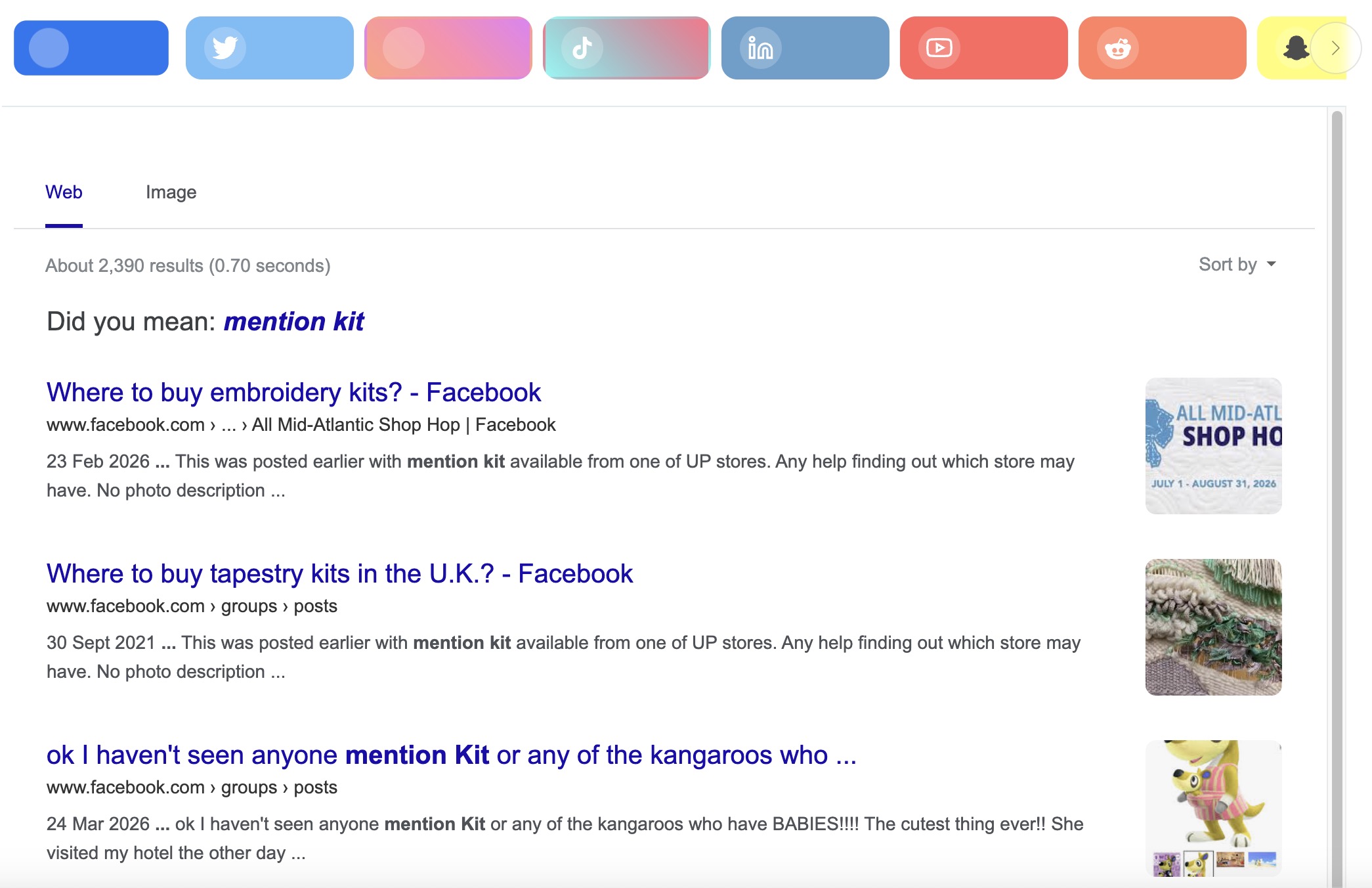
The screenshot above shows the problem. A search for Mentionkit brings back results about embroidery kits, tapestry kits, and a random post that says “mention Kit.” None of that helps a brand, agency, or founder find useful product mentions.
Social Searcher is best for quick public search. A brand mention tracking workflow needs extra steps around ownership, scoring, replies, and reporting.
1. You have to remember to search.
Manual search only works when someone opens the tool and types the query. If nobody checks today, today’s useful thread can pass by.
2. Search results depend on indexed public pages.
Social Searcher’s own Google Social Search page says it uses Google Programmable Search Engine to show public results. You are working from search-indexed content, so the data may be late, partial, or missing context.
3. Contextually irrelevant results are common.
Google search can match words without understanding your brand. A phrase like “mention kit” can mean your company, a craft kit, or two unrelated words next to each other.
4. Search does not create ownership.
Finding a mention is the first step. Someone still needs to decide if it matters, write a reply, mark it handled, and track the result.
5. Search does not score what matters.
Most broad brand and category terms bring junk. You need a way to sort brand mentions, competitor mentions, product questions, complaints, and buying posts.
6. It is a poor fit for agencies and brands.
Agencies and brands usually need reporting, shared access, user management, assignment, filters, and a clear record of what happened. These can sound like bells and whistles, but they are expected basics in a proper social listening tool.
This is the same issue many businesses hit with free alert tools. Our Google Alerts alternative page covers that same upgrade path: search and alerts are useful, but work still needs a home.
Best Social Searcher alternative: Mentionkit
The best Social Searcher alternative for brand mention tracking is Mentionkit if your goal is to act on mentions after you find them.
Mentionkit is a social monitoring tool built around a simple loop:
- Track keywords.
- Review mentions in one feed.
- Mark what happened.
- Report on handled work.
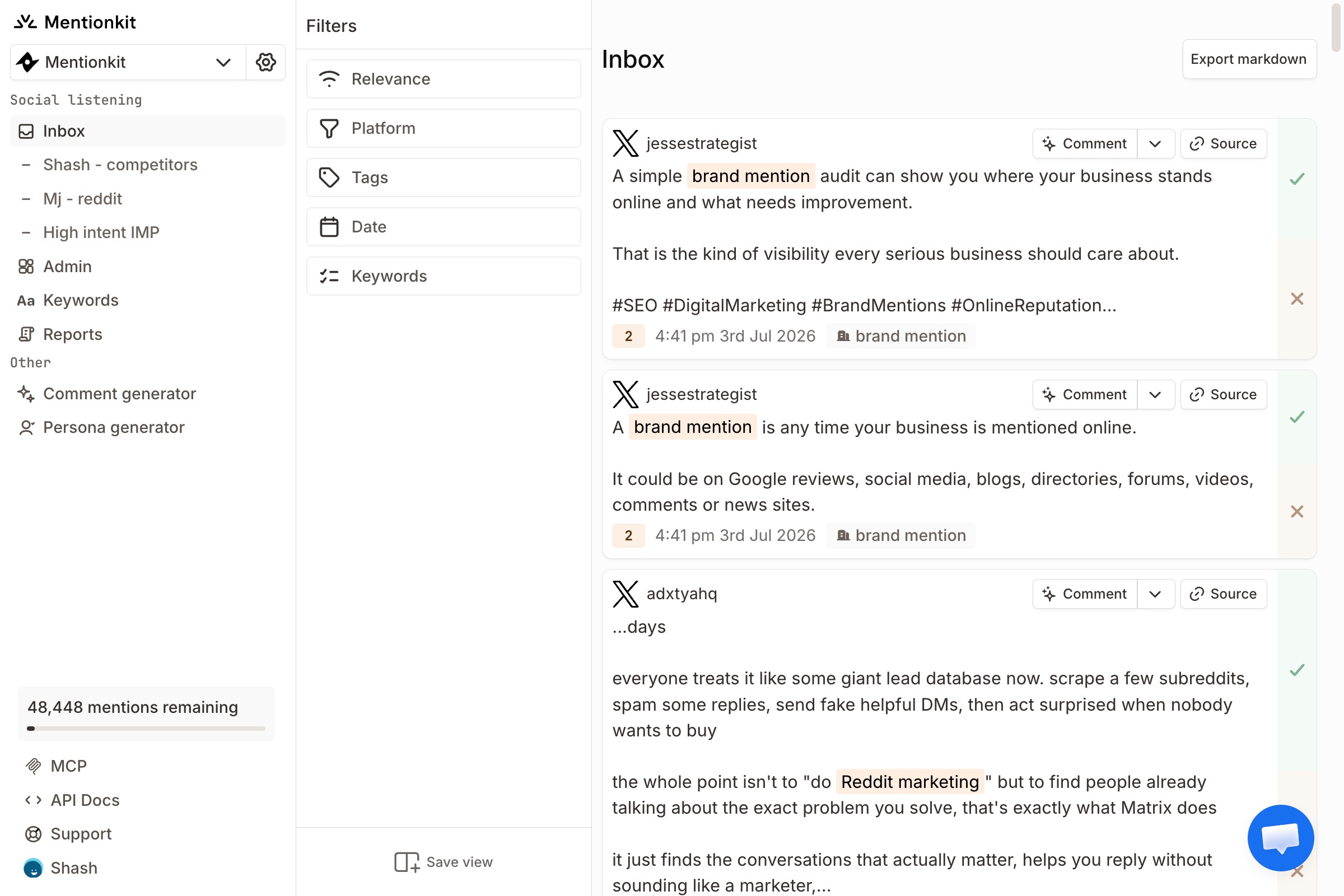
For each mention, we give it a score from 1-5. 1 means thrash, and 5 means you need to reply to this mention.
We also auto-tag each mention with sentiment, eg positive/negative, alternatives, insight, etc. This helps you easily track down mentions with a certain sentiment.
In essence, Social Searcher helps you look. Mentionkit helps you run the work.
| Need | Social Searcher | Mentionkit |
|---|---|---|
| Quick public lookup | Strong fit | Works, but built for ongoing tracking |
| Saved keyword tracking | Limited by manual search behavior | Built around tracked keywords |
| Brand mention feed | Search results view | One mention inbox |
| Relevance scoring | Manual review | Relevance workflows and tags |
| AI reply help | Outside its main use case | AI draft replies |
| Ownership | Manual notes outside the tool | Mention ownership and status |
| User management | No shared workflow | Shared access for businesses |
| Reporting | Manual summary | Reports for handled work |
| API, webhooks, MCP | Social Searcher says it does not use APIs for platform data | API, webhooks, and MCP support |
Mentionkit tracks public mentions across Reddit, X, LinkedIn, TikTok, Bluesky, YouTube, Hacker News, and GitHub. It fits businesses that need a daily brand tracking tool, competitor monitoring setup, or buyer-intent workflow.
If you are still learning the category, read our guide on what social listening is. If API access is part of your plan, this social media listening API guide explains what to check before you buy.
When Social Searcher is still enough
Use it when you need a basic public loop, quick brand mention check.
For example, a solo founder might search their brand name once a week. A marketer might check a hashtag before a campaign. A journalist might use it for public discovery.
Move to a Social Searcher alternative when the job becomes repeatable and tied to outcomes.
Use a proper social monitoring tool when you want to track brand mentions over time, with real-time alerts and relevance filtering and tagging.
A good mention workflow should answer four plain questions:
| Question | Why it matters |
|---|---|
| Is this mention useful? | Cuts out low-value chatter |
| What type of mention is it? | Separates leads, complaints, praise, and research |
| Who owns the reply? | Stops work from sitting untouched |
| What happened next? | Makes reporting simple |
For a deeper playbook, read our guide to brand mention monitoring. If you want a wider tool list, this top social listening tools guide compares more options.
How to choose a Social Searcher alternative
Do not start with the biggest feature list.
Start with the work your business needs to do every week.
If you only need search, keep Social Searcher.
Free lookup tools are hard to beat for fast checks. There is no reason to pay for a dashboard if you only need occasional public search.
If you need alerts and review, choose a monitoring tool.
Saved keywords, source coverage, and an inbox matter here. Your business should not depend on someone remembering to search.
If you need replies and reports, choose a workflow tool.
With Mentionkit, you can track the mention, decide if it matters, draft the reply, assign it, and show what was handled.
If you need raw data, check API access early.
Mentionkit gives you both a product workflow and API access, plus webhooks and MCP support for AI-assisted work.
If you need broad enterprise analytics, compare larger suites.
Mentionkit is built for practical social monitoring. If your business needs a giant research suite with heavy dashboards and long onboarding, a larger platform may fit better.
Conclusion
Social Searcher is useful for quick lookup. If your business needs ongoing brand mention tracking, buyer-intent discovery, competitor monitoring, replies, ownership, reporting, API access, webhooks, or MCP, you need more than a search box.
Mentionkit is the better Social Searcher alternative when you want a practical social monitoring tool. It helps you track public mentions, review the best conversations, draft replies, assign work, and report what was handled before the conversation goes cold.