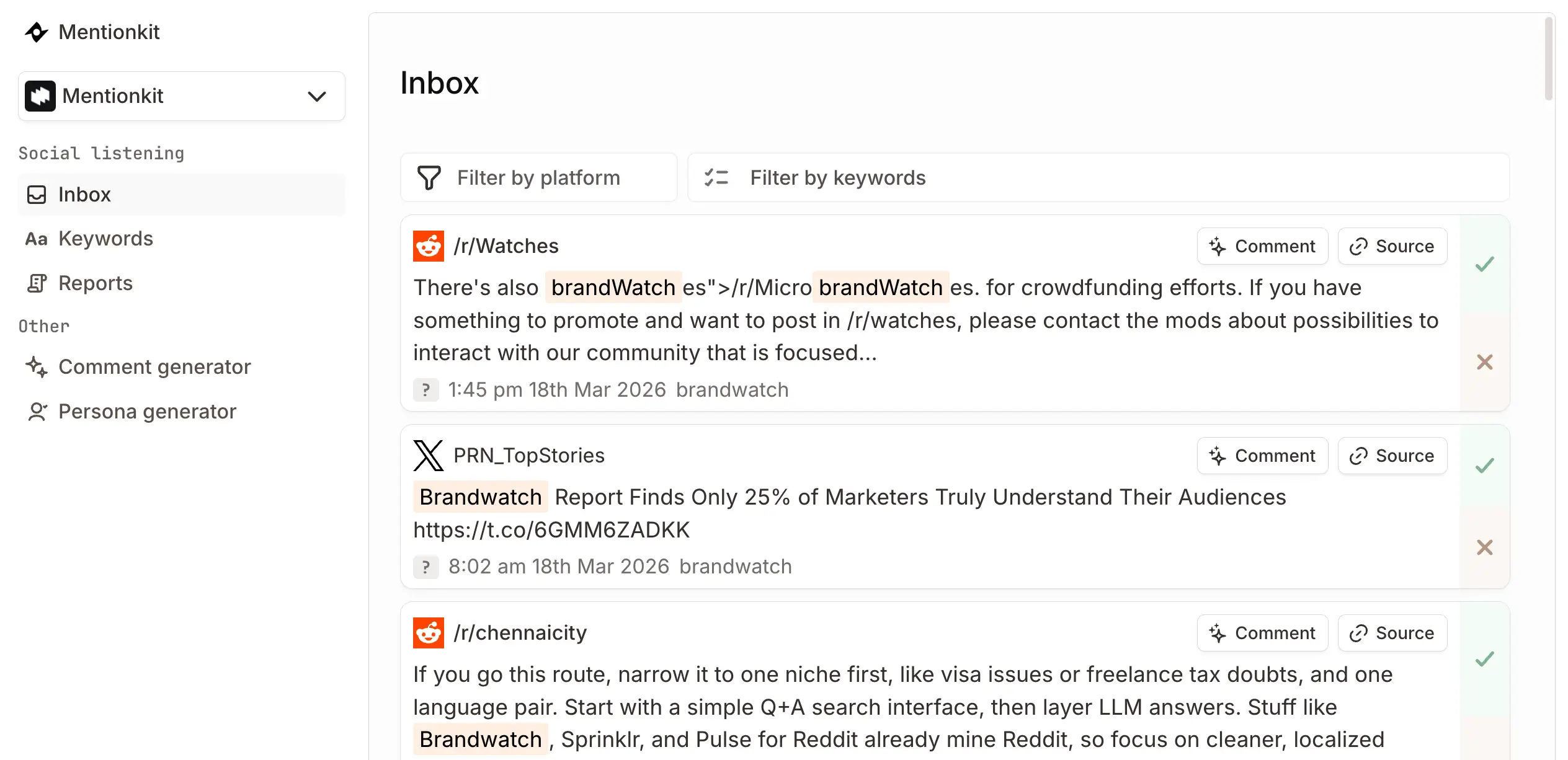
A single subreddit thread can outperform a week of scheduled social posts.
I learned that the practical way. I mentioned my own product in an automation-focused subreddit, logged off, and expected very little. When I came back, the thread had taken off and brought in around seven to eight signups. Not from a campaign dashboard. Not from a polished landing page test. From one conversation where people were already looking for a solution.
From a Single Comment to Eight New Customers
That’s why I treat brand mention monitoring as a growth workflow, not a PR task.
If people mention your brand, compare you to a competitor, ask for an alternative, or describe the exact problem your product solves, that’s demand showing up in public. The job is to catch it before it goes cold.
What brand mention monitoring actually is
At the simplest level, brand mention monitoring means tracking where your brand shows up online and deciding whether that mention deserves action.
That includes obvious cases, like someone naming your company directly. It also includes indirect cases, like:
- Comparison threads where buyers ask for alternatives
- Problem posts where someone describes a pain point your product fixes
- Customer feedback that tells you what people repeat back about your positioning
- Competitor mentions that reveal where buyers are unhappy or confused
If you want a clean primer on the basics, Sight AI’s guide on What is brand monitoring is a solid starting point.
The part most teams miss
Teams often overcomplicate the setup and underthink the decision-making.
They spend too much time asking which tool to buy and not enough time asking what deserves a response. A mention feed without prioritization turns into another noisy inbox. A focused workflow turns into sales conversations, support saves, product insight, and better positioning.
Practical rule: Don’t monitor the internet. Monitor moments that can change pipeline, reputation, or product direction.
The Reddit example mattered because it wasn’t random attention. It was the right audience, in the right context, at the right time.
That’s the lens I use now. I’m not trying to collect every mention. I’m trying to catch the ones that signal intent.
And that changes everything. Once you stop treating mentions as vanity and start treating them as live market feedback, the workflow gets much clearer. You track fewer things, ignore more noise, and respond with a lot more purpose.
Why Brand Mentions Are Your Best Growth Channel
Brand mentions sit closer to purchase intent than many realize.
Search ads catch explicit demand. Brand mentions often catch the messy middle, where buyers ask peers what to use, complain about current tools, or narrow down options in public. Those conversations are harder to script against and easier to win if you show up helpfully.
Mentions reveal demand before forms do
A lot of high-intent buying behavior doesn’t start on your site.
It starts when someone asks coworkers for recommendations on LinkedIn. Or posts on Reddit that they’re tired of a bloated incumbent. Or tweets that they need a tool that does one very specific job and doesn’t cost a fortune.
Those moments matter because the buyer is telling you, in plain language, what they want and what they reject. You don’t have to infer it from ad click behavior.
They also tell you whether the market can see you
Visibility isn’t just traffic. It’s whether your brand appears often enough in category conversations to become a default option.
The market for monitoring that visibility has grown fast. The global social listening market was valued at $12.3 billion in 2023 and is projected to reach $32.5 billion by 2030, while brands with higher share of voice can see up to 25% better campaign ROI, according to Idea Digital’s overview of brand mention tracking tools.
That tracks with what I’ve seen in practice. Teams that monitor mentions consistently don’t just protect reputation. They notice category conversations earlier, get named more often, and learn where they’re absent.
The value isn’t in being mentioned once. It’s in being mentioned often enough that buyers start seeing you as part of the shortlist.
Three growth uses that justify the effort
Lead capture
This is the most obvious use, and still the one many teams underwork. If someone asks for recommendations or alternatives, that’s a warm opening if you can add context without sounding desperate.
Product feedback
Mention feeds show what customers repeat when you aren’t in the room. That matters more than polished survey language. You’ll see which feature gets remembered, which complaint keeps resurfacing, and which competitor narrative is spreading.
Competitive intelligence
You don’t need a formal win-loss program to learn a lot. Watch where competitors get praised, where they frustrate users, and what language customers use when switching.
A quick walkthrough helps if you’re building this muscle into your team’s routine:
Why this channel beats passive listening
Passive monitoring is useful for reporting. Active monitoring is useful for growth.
The difference is simple. Passive teams collect dashboards. Active teams route mentions into actions:
- A recommendation request becomes outreach
- A confused customer comment becomes onboarding copy
- A competitor complaint becomes sales positioning
- A positive mention becomes proof you can reuse later
That’s why I rank brand mention monitoring so highly. It gives you lead discovery, message testing, and market research in the same stream, if you’re disciplined enough to filter it properly.
What to Track and Where to Find It
Teams often start too broad.
They dump every possible keyword into a monitoring tool, drown in junk, and then stop checking it. A better setup starts narrow and expands only when you know why each query exists.
Start with the obvious terms
My default setup is simple:
- Brand name: Track the exact company or product name first.
- Common misspellings: I usually add one or two. That captures the sloppiness people use in posts and comments.
- Competitor names: Not to obsess over them, but to catch comparison threads and switching conversations.
I usually don’t add a giant long-tail list. I’d rather use AI filtering to pull out high-value mentions from a tighter set than manage an oversized keyword library.
Add intent, not keyword clutter
The highest-value mentions often aren’t brand mentions in the strict sense. They’re commercial conversations.
That’s where phrases like “alternative to,” “recommend,” “looking for,” or “what do you use for” become useful. If you need a deeper framework for recognizing these patterns, Salesmotion’s guide to buying signals is worth reading.
A related concept is social listening. If you want a practical distinction between watching direct mentions and tracking broader conversations, this overview on https://mentionkit.com/articles/what-is-social-listening is useful.
Prioritize platforms by how people actually talk
Different channels produce different kinds of value.
Reddit is where buyers explain context. You often get the full story, what they’ve tried, why they’re frustrated, and what they need next. Response speed matters less than relevance.
LinkedIn is useful for category discussions, peer recommendations, and professional credibility. People are more identity-attached there, so the tone tends to be safer and more polished.
X
X can surface mentions quickly, but it also produces a lot of low-value noise. I see the most obvious AI-written junk and thin copywriter spam in this area. I ignore most of it.
Hacker News and niche forums
These matter when your buyers are technical or opinionated. The volume is lower, but the signal can be strong.
If your audience lives in a niche community, one good thread can matter more than a broad social campaign.
Use sentiment for prioritization, not decoration
Sentiment analysis is only useful if it changes what your team does next.
A healthy brand often sees mention mix around 45% positive, 40% neutral, and 15% negative, and a rise in negative mentions of more than 20% in 48 hours can signal a potential crisis, based on Prowly’s explanation of brand mentions and sentiment tracking.
That doesn’t mean every negative mention needs a public reply. It means negative clusters deserve review fast, especially if they come from customers, influential accounts, or repeated complaint themes.
A good monitoring setup should help you answer four questions quickly:
| Question | Why it matters |
|---|---|
| Is this mention relevant? | Cuts out obvious noise |
| Is there intent here? | Separates chatter from opportunity |
| Does it require a response? | Prevents over-engagement |
| Who owns it? | Stops mentions from sitting unhandled |
That last question is where most workflows fail. Teams see mentions, but no one is clearly responsible for acting on them.
Building Your Mention Monitoring Workflow
The best workflow isn’t the fastest one. It’s the one your team will keep using.
I used to think instant replies were always better. In practice, they often aren’t, especially on Reddit. A thoughtful reply a little later usually beats a rushed reply right now.
The cadence I’d actually recommend
I monitor a couple of times during working hours.
That’s enough to stay on top of meaningful conversations without turning mention monitoring into a full-time interruption machine. For many teams, a sustainable review rhythm beats constant pings.
Modern tools can alert very quickly. Real-time alerting systems can trigger notifications for high-intent mentions in less than 5 seconds, and those alerts are associated with a 25 to 35% uplift in response rates and lead conversion, according to BrandMentions.
That speed is useful. But it doesn’t mean every mention deserves an immediate human reaction.
My daily triage flow
Morning scan
Open the feed and look for anything urgent first. Negative customer issues, direct comparison threads, recommendation requests, and mentions from accounts that can influence others all go to the top.
Noise removal
Discipline is essential here. I throw out obvious AI-written fluff, low-value spam on X, duplicate chatter, and generic posts with no real audience or context.
Ignoring bad mentions is part of the job. If you engage with junk, you train yourself to confuse motion with progress.
Relevance check
At this stage I care about context more than volume. Is the post asking a genuine question? Is the person describing a real problem? Are they deciding between products? Is there room for a useful reply?
AI relevance scoring is beneficial here. Mentionkit, for example, tracks conversations across Reddit, X, LinkedIn, and Hacker News, then assigns an AI relevance score so teams can prioritize worthwhile posts instead of reviewing every raw mention.
Action routing
Every mention should land in one of a few buckets:
- Reply now: Recommendation requests, direct questions, fixable complaints
- Monitor only: Threads with weak fit or uncertain context
- Escalate: Sensitive support, reputation, or legal issues
- Ignore: Spam, bots, obvious low-value noise
Mark complete
Handled mentions should be closed out or tagged clearly. Otherwise the same post gets reviewed multiple times by different people, which wastes attention fast.
Keep ownership boring and obvious
The cleanest systems aren’t fancy. They just make ownership impossible to miss.
A simple structure works:
| Mention type | Owner | Expected action |
|---|---|---|
| Recommendation or alternative request | Growth or sales | Join conversation helpfully |
| Support complaint | Support or customer success | Resolve or route |
| Positive customer praise | Social or community | Thank, amplify, save proof |
| Competitor comparison | Growth or product marketing | Capture insight, reply if relevant |
If you want alerts to feed the rest of your stack, webhooks make that easier. This documentation on https://mentionkit.com/docs/webhooks shows the kind of routing that helps teams push high-priority mentions into existing workflows.
Operating principle: Fast alerts are useful. Fast judgment is better.
What works and what doesn’t
What works:
- Checking at set times
- Filtering aggressively
- Using relevance scoring
- Routing by intent and owner
- Writing responses that fit the platform
What doesn’t:
- Replying to everything
- Treating every mention as a lead
- Letting alerts interrupt the whole day
- Using one generic response across Reddit, LinkedIn, and X
- Collecting mentions without closing the loop
Busy teams don’t need more dashboards. They need a small system that turns a stream of mentions into a queue of decisions.
How to Respond to Different Types of Mentions
The response is where brand mention monitoring either creates value or turns into cringe.
The rule is simple. Match the tone of the platform, answer the actual point, and don’t force a pitch where a helpful comment would do more.
Positive mentions
When someone says something good about your product, don’t waste it with a corporate thank-you that sounds copied from a community manager handbook.
A short, human reply works better. Thank them, acknowledge the specific thing they liked, and, if it makes sense, ask a light follow-up question you can learn from.
Example:
Appreciate that. Glad the setup felt straightforward. If anything still feels clunky, I’d love to know where.
That kind of response keeps the conversation open without sounding needy.
Negative mentions
Negative mentions need calm handling. Don’t get defensive. Don’t argue facts publicly unless you’re correcting something important. Start by showing you understood the complaint.
A useful pattern is:
- Acknowledge the issue
- Clarify if needed
- Offer the next step
- Take details private if the thread gets messy
If people feel heard, a lot of tension drops quickly.
Neutral recommendation threads
These moments offer the highest impact.
Someone asks for a tool, an alternative, or a recommendation. You don’t need a hard sell. You need a credible, context-aware answer that helps the buyer compare options.
I’ve found it works better to explain fit than to push features. Say who the product is for, where it works well, and where it may not be ideal. That honesty builds trust fast.
If you want more examples of turning social conversations into pipeline, this article on https://mentionkit.com/articles/lead-generation-from-social-media covers the process well.
Outreach Response Templates
| Mention Type | Objective | Template |
|---|---|---|
| Positive customer mention | Reinforce goodwill and gather insight | Thanks for the mention. Glad it’s been useful for [specific use case]. If you ever hit friction, I’m happy to help. |
| Negative complaint | De-escalate and move toward resolution | Sorry you ran into that. That’s frustrating. If you’re open to it, send over the details and I’ll help get it sorted. |
| Recommendation request | Join naturally and qualify fit | If you’re comparing options, [brand] could be a fit if you care most about [specific outcome]. If you share your use case, I can tell you whether it makes sense or not. |
| Competitor comparison | Add clarity without sounding combative | It depends on what you need. [Competitor] may be better for [scenario]. [Brand] tends to fit better when [specific constraint or goal] matters more. |
| Unclear curiosity | Start a conversation | Happy to help if useful. What are you trying to solve, and what have you tested already? |
Don’t sound optimized. Sound useful.
That’s the difference between a reply that gets ignored and one that starts a deal.
Common Pitfalls and How to Avoid Them
The biggest mistake in brand mention monitoring is assuming more coverage automatically means more value.
It usually means more noise.
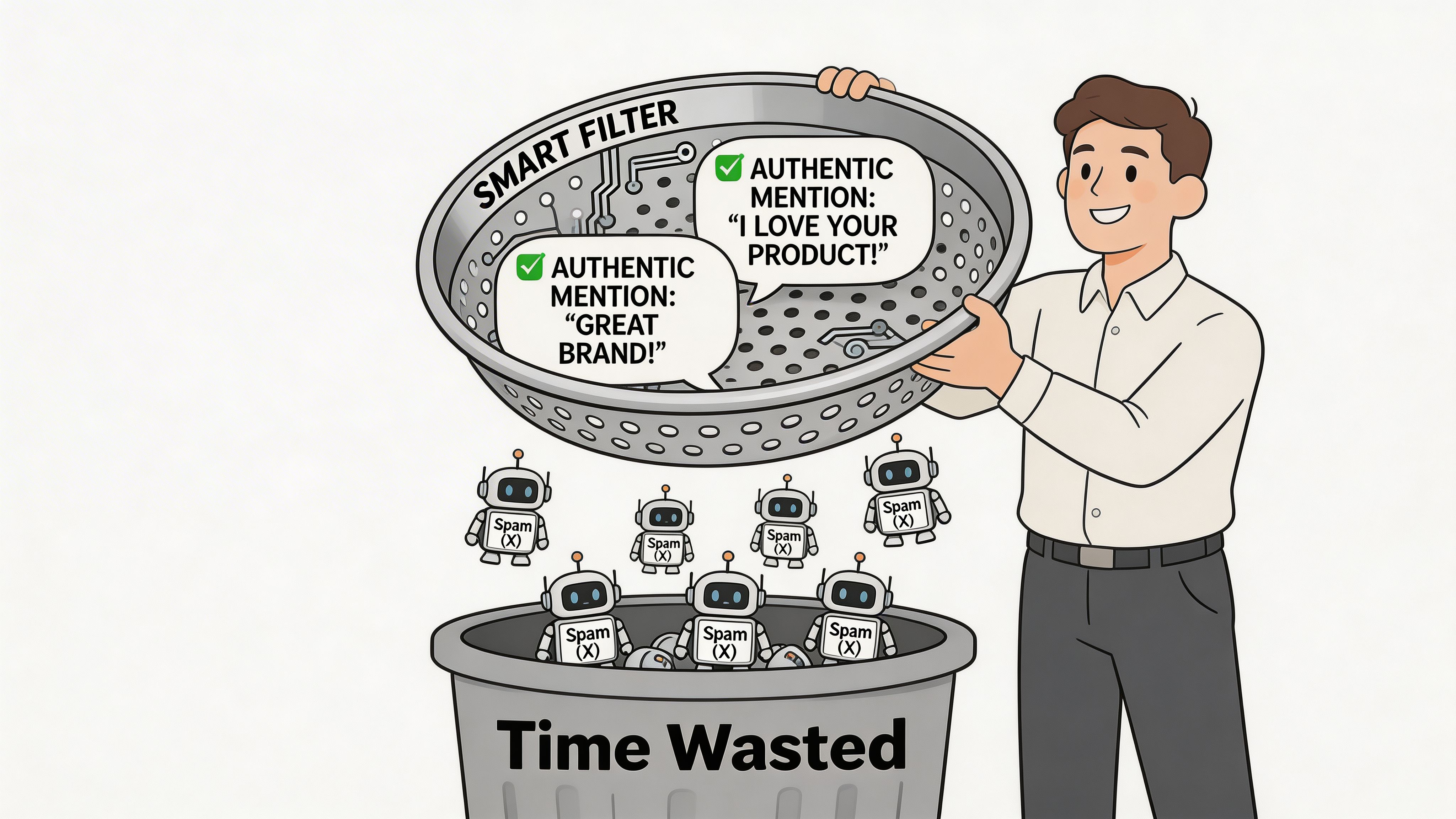
Pitfall one: chasing obvious spam
A lot of low-quality mentions look active but go nowhere. On X in particular, I see plenty of AI-written posts and shallow spam written to mimic engagement.
Ignore them.
If a mention has no real context, no real audience, and no believable intent, it doesn’t deserve your time. Teams lose more productivity from weak filtering than from missing the occasional marginal mention.
Pitfall two: tracking too many keywords
More keywords feels safer. In practice, it floods the queue and makes people stop checking alerts.
Start with:
- Brand name
- One or two misspellings
- Core competitor names
- A few high-intent phrases
Add terms only when they produce useful conversations.
Pitfall three: no clear owner
If everyone can respond, nobody owns the queue.
Assign mention types to specific people or teams. Sales handles recommendation threads. Support handles product issues. Community handles praise and lightweight engagement. Without that structure, mentions sit untouched or get inconsistent replies.
Pitfall four: relying on outdated workflows
Google Alerts still has a place for lightweight monitoring, but it misses too much of the conversation modern buyers have in communities and social threads.
Use it if you need a minimal starting point. Don’t mistake it for full coverage.
Pitfall five: replying too fast and too often
Speed helps in some channels. It’s overrated in others.
Reddit especially rewards relevance more than immediacy. A good reply after you’ve read the thread properly often performs better than a quick, generic comment dropped in seconds after posting.
Making Monitoring a Sustainable Habit
The teams that win with brand mention monitoring don’t treat it like a special campaign.
They make it a repeatable habit. Small keyword set. High-value channels. Strong filtering. Clear ownership. A few response patterns that sound human. That’s enough.
You don’t need to review every mention the moment it appears. You need a system that helps you spot the ones worth acting on and ignore the rest without guilt.
If your current process feels heavy, shrink it. Check mentions a couple of times during working hours. Prioritize intent over volume. Save examples of replies that worked. Refine your filters every week.
That’s when monitoring stops feeling like another marketing chore and starts acting like a practical growth engine.
If you want a simple way to put this into practice, Mentionkit is built for tracking high-intent conversations across Reddit, X, LinkedIn, and Hacker News, with AI relevance scoring to help busy teams focus on mentions that are worth a response.