
Your brand can look popular on Google and still be missing from the places where buyers ask for advice.
A buyer may see your site in search, read a complaint about you on Reddit, then ask ChatGPT for the best option. Each place tells a different story. If you only track one of them, you miss part of the buying path.
This guide explains AI brand monitoring across social media, search, and large language models (LLMs). You will learn what to track, how to run a simple audit, and what to do with the results.
What is AI brand monitoring?
AI brand monitoring is the process of finding and reviewing what people and AI systems say about your brand. It covers three main areas:
- Social: Posts, comments, videos, and public talks about your brand, competitors, or the problem you solve.
- Search: Pages that rank for your brand, product type, reviews, and comparison terms.
- LLMs: Answers from tools such as ChatGPT, Claude, Gemini, and Perplexity.
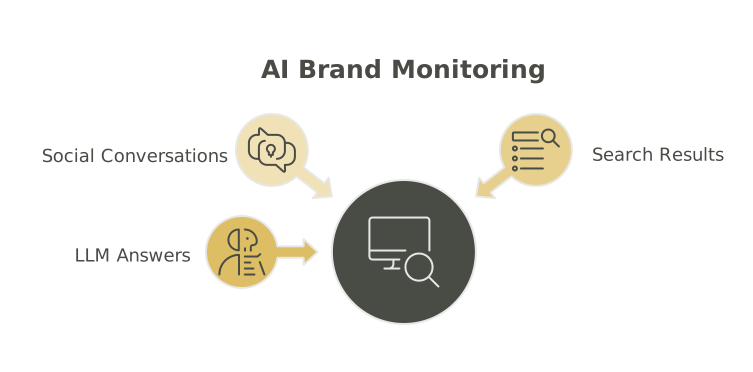
The word “AI” has two jobs here. First, AI helps sort large amounts of brand data. It can score relevance, group common topics, and flag positive or negative comments. Second, LLM answers have become a new place where brands appear.
Each area needs its own method. Social posts arrive all day. Search results change more slowly. LLM answers can change when you alter a prompt, switch models, or ask the same question again. People who track LLM visibility by hand often report this same problem in Reddit discussions about prompt tracking.
This means a single screenshot proves very little. You need a fixed set of checks that you repeat over time.
How to track AI brand mentions across all three areas
Start with a small list of names and questions. A broad list creates noise and makes the review hard to keep up.
Build your tracking list
Write down:
- your brand and product names
- common misspellings
- two to five competitor names
- your main product type
- three problems your product solves
- buying terms such as “best,” “reviews,” “vs,” and “alternatives”
For Mentionkit, a useful list would include Mentionkit, social monitoring tool, Reddit keyword tracking, and close competitors. A business that sells payroll software would track its brand, key rivals, “payroll software,” and questions about payroll errors or late pay.
1. Track social conversations
Use a social monitoring tool to watch public posts across the platforms where your buyers spend time. Track direct brand names first. Then add competitor names and a few problem terms.
Review mentions by intent:
- Support: A customer needs help.
- Reputation: A public claim needs a clear reply.
- Buying: Someone asks for a tool, review, or alternative.
- Research: A comment points to a product or content gap.
- Praise: A happy customer gives you proof you can share with permission.
Do not treat every match as useful. A common brand name can bring in many unrelated posts. Relevance scoring and focused keywords help cut that noise.
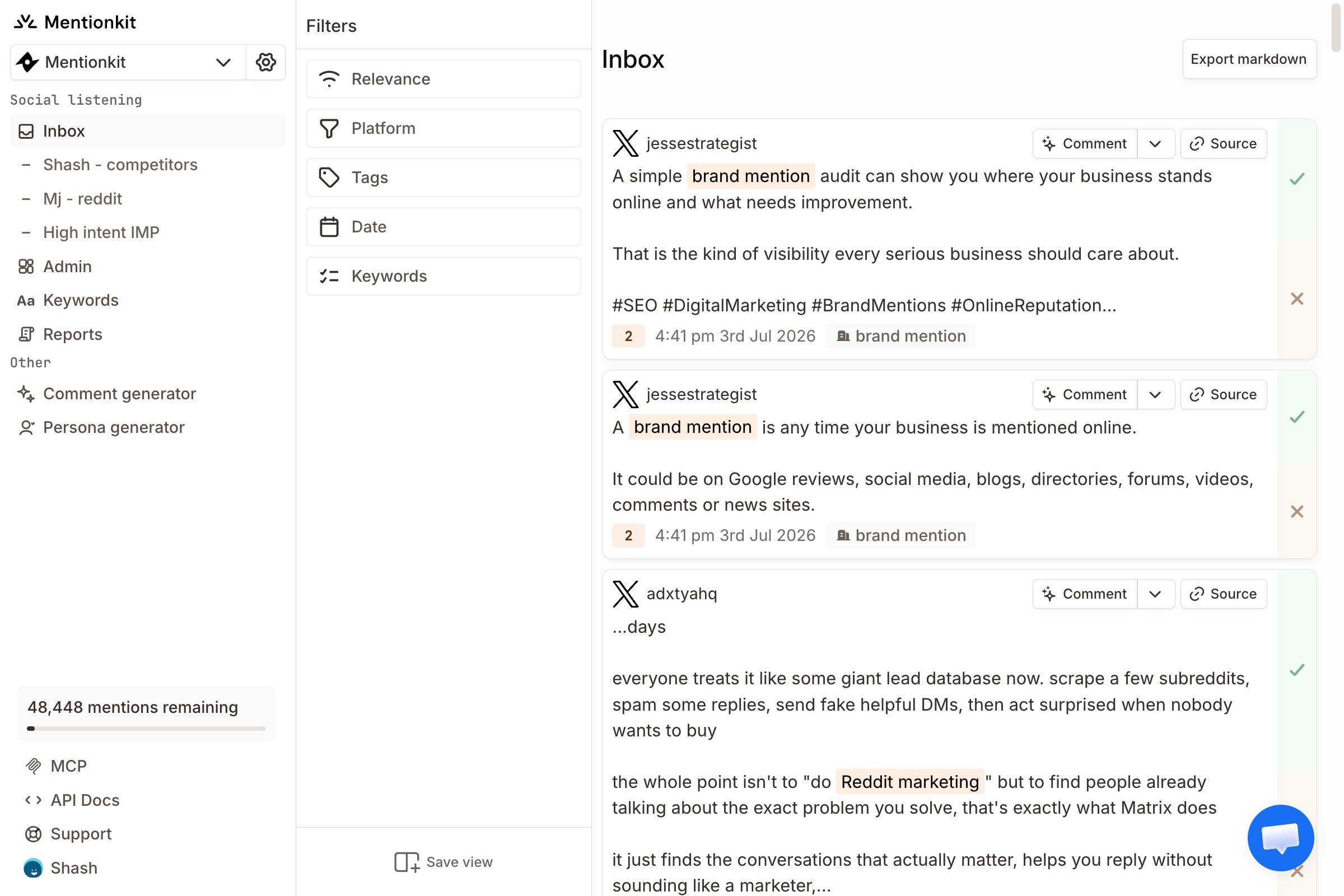
Our brand mention monitoring guide goes deeper into keyword choice and reply workflows. You can also use competitor monitoring to find comparison posts and common complaints.
2. Check search results
Search your brand in a private browser window. Then search the terms a buyer would use before they know your name.
Check these query types:
[brand] reviews[brand] pricing[brand] vs [competitor][brand] alternativesbest [product type] for [use case]how to solve [buyer problem]
Record which pages rank, how your brand is described, and which rivals appear. Look at review sites, news pages, Reddit threads, videos, and your own pages. An old review or a wrong price can shape a buyer’s view before they visit your site.
Use Google Search Console to track clicks, impressions, and search terms for your own pages. A rank tracker can watch wider changes. Search results vary by place, device, and user history, so use the same setup each time.
3. Check LLM answers
Create 10 to 20 prompts based on buyer questions. Split them into three groups:
- Brand prompts: “What is [brand]?” or “Is [brand] good for agencies?”
- Category prompts: “What are the best tools for [use case]?”
- Problem prompts: “How can I find people asking for [product type] on Reddit?”
Run the same prompts in ChatGPT, Claude, Gemini, and Perplexity. Save the full answer, date, model, brand position, rivals named, tone, and cited links.
Measure four simple numbers:
| Metric | What it shows |
|---|---|
| Mention rate | The share of answers that name your brand |
| Share of voice | Your mentions compared with named rivals |
| Citation rate | The share of answers that link to your site |
| Message accuracy | How often the answer gets your product facts right |
Repeat each prompt more than once when the choice is important. LLM output varies, so one answer should not guide a large content change. Keep your prompt list stable for a month. Add new prompts when your buyers start asking new questions.
For a focused walkthrough, read how to track brand mentions in ChatGPT. Our guide to measuring generative engine optimization also shows how to connect prompt checks with business results.
Turn monitoring data into useful work
A dashboard has little value until it leads to an action. Run a 30-minute review each week and sort each finding into one of four lists.
Reply now
Reply to support questions, buyer requests, and false claims while the post is still active. Lead with help. State your link to the product when you mention it. A short, honest answer works better than a sales pitch.
Fix wrong facts
Update pages that show old prices, features, platform lists, or brand wording. Ask third-party sites to fix clear errors. If an LLM cites a page with bad facts, improve the source page first.
Fill content gaps
Look for questions where rivals appear and your brand does not. Publish a page only when you can answer the question well. Useful pages include clear use cases, fair comparisons, pricing details, setup guides, and original product data.
Research on AI recommendations keeps pointing back to the sources that models can find and cite. A recent study of brand reputation in AI answers focused on the role of retrieved web citations across markets and languages. This makes clear, current, and well-linked pages a practical place to start.
Watch changes
Compare results each month. A short scorecard is enough:
| Area | Monthly check |
|---|---|
| Social | Useful mentions, reply rate, common topics |
| Search | Branded results, top pages, wrong facts |
| LLMs | Mention rate, citations, rivals, message accuracy |
Do not blend all three areas into one score. Ten social comments and ten LLM answers do not mean the same thing. Keep each area separate, then review the full story together.
Conclusion
AI brand monitoring gives you a wider view of how buyers find and judge your business. Social conversations show what people say now. Search shows which pages shape the story. LLM answers show which brands and sources get picked for a question.
Start small. Track a focused keyword list, check a fixed set of search terms, and run the same 10 to 20 prompts each month. Reply to useful posts, fix wrong facts, and write pages that answer clear buyer questions.
Mentionkit helps with the social part of this work. You can track brand, competitor, and buyer terms across Reddit, X, LinkedIn, TikTok, Bluesky, YouTube, Hacker News, and GitHub. Its inbox, relevance scores, tags, reports, API, webhooks, and MCP support help you move from a public mention to the next action.