
Google Alerts can tell you when a new web page mentions your brand. Buyers also ask about products in Reddit comments, compare rivals on LinkedIn, and complain in posts on X. By the time a post reaches Google Search, the best time to reply is often gone.
This guide compares the best Google Alerts alternatives for social and brand monitoring in 2026. I looked at source coverage, alert speed, filtering, reports, and the work you can do after you find a mention.
My short answer is simple: use Google Alerts for free web and news checks. Choose a social monitoring tool when public posts affect support, product feedback, or your brand.
Google Alerts vs social listening
Google Alerts sends an email when Google Search finds a new result for a topic. You can pick the source type, language, region, result count, and delivery rate. It is free and takes a few minutes to set up.
That makes it useful for:
- company names in news stories
- founder names on public web pages
- new pages that mention a product or campaign
- broad updates on a market topic
Google Alerts watches pages that appear in Google Search. A social listening tool watches supported social platforms and forums, then helps you review what people said. Google Alerts is useful for web and news coverage. Social listening is useful for direct brand posts, untagged mentions, comments, product questions, and competitor discussions.
The gaps show up when you need to act fast. Google Alerts does not give you a complete feed of social posts and comments. It also lacks mention ownership, status tracking, AI sorting, and client reports.
People in a Reddit discussion about brand monitoring raised the same issue: missed mentions and slow alerts make it hard to join high-intent talks on time. Another founder said they use separate tools for web mentions, social posts, and competitor page changes. One alert tool rarely covers every job well.
Look for an alternative if you need one or more of these features:
- posts and comments from social platforms
- faster alerts for buyer questions or complaints
- filters for intent, relevance, or sentiment
- one inbox for review and follow-up
- reports for clients or business leaders
- API or webhook access
For a deeper look at the process, read our guide to brand mention monitoring.
Before you pay for a new tool, clean up your Google Alerts. Put exact brand names in quotation marks. Create separate alerts for common misspellings. Add a minus sign before words that cause false matches. A brand called Linear, for example, needs extra terms to avoid pages about math.
Keep each alert focused on one job. One alert can track your brand. Another can track a founder. A third can track a competitor with words such as “review,” “alternative,” or “problem.” Focused alerts are easier to judge than one long search with many terms.
This cleanup gives you a fair test. If Google still misses useful posts after one week, you can show exactly what the new tool needs to find.
7 best Google Alerts alternatives in 2026
| Tool | Best for | Free option | Main limit |
|---|---|---|---|
| Mentionkit | Social mentions and follow-up | 14-day trial | Less suited to deep enterprise research |
| Talkwalker Alerts | Free web alerts | Yes | Basic alert workflow |
| F5Bot | Reddit, Hacker News, and Lobsters | Yes | Narrow source list |
| Brand24 | Broad monitoring and reports | Trial | Starts at a higher price |
| Awario | Lower-cost social listening | Trial | Reports and analysis are lighter |
| Mention | Enterprise social and media monitoring | Demo | Annual, quote-based Company plan |
| Brandwatch | Enterprise research | No simple free plan | High cost and setup needs |
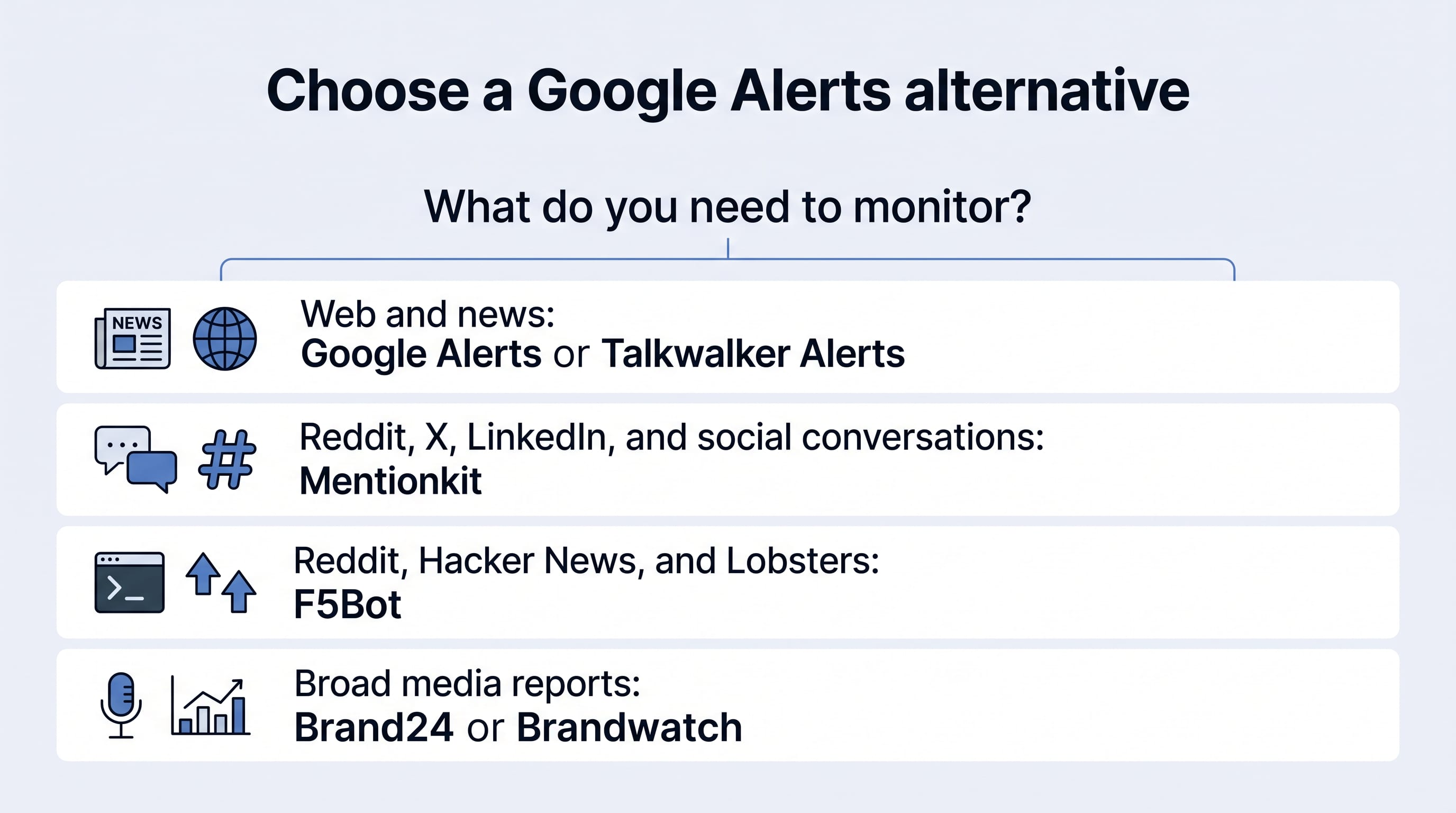
I would start with the smallest tool that covers your buyers. F5Bot is enough for many developer products. Mentionkit fits businesses that need several social platforms and a clear follow-up process. Brand24 and Brandwatch make more sense when media reports and research are part of the job.
1. Mentionkit: best for finding social mentions and acting on them
Mentionkit tracks brand, keyword, and competitor mentions across Reddit, X, LinkedIn, YouTube, GitHub, Slack, forums, and other sources. It brings mentions into one feed and uses AI filtering to put actionable mentions first.
The workflow is the main reason to pick it. A business can review a mention, give it to an owner, add comments, and record what happened. Filters and reports help agencies and growing businesses keep the work clear.
Mentionkit is a strong fit when you want to find:
- direct brand mentions
- untagged product mentions
- customer questions and complaints
- competitor comparisons
- feature feedback
- competitor complaints
- posts asking for product advice when lead discovery is useful
The Base plan costs $49 per month, and the trial lasts 14 days. It includes 10 keywords, 10 trackers, one project, unlimited mentions, API access, MCP, webhooks, email alerts, and Slack alerts. Businesses that mainly need deep market research across many media sources will get more from a larger suite.
2. Talkwalker Alerts: best free web alert alternative
Talkwalker Alerts is the closest free swap for Google Alerts. It tracks mentions across online sources and sends results by email. It is a good second check for brand names, people, topics, and news.
Choose it if your main goal is wider free web alerts. You still need a paid social listening product for a shared inbox, detailed reports, and daily response work.
Run the same search in Google Alerts and Talkwalker Alerts for seven days. Keep both if each one finds useful pages the other misses. This free pair is a good fit for a small business that checks alerts once or twice a week.
3. F5Bot: best free choice for Reddit and Hacker News
F5Bot watches Reddit, Hacker News, and Lobsters. It checks posts and comments, then sends keyword matches by email. Its free plan supports five keywords, with alerts delivered within two hours. Paid plans add faster delivery and better filters.
F5Bot is a smart pick for a developer product or a B2B SaaS business whose buyers spend time in these communities. Its focused source list keeps the product simple. You will need another tool for X, LinkedIn, YouTube, and broad news monitoring.
The free plan has daily caps, so use it for brand names, domains, and a few close rivals. Broad terms such as “CRM” or “marketing” create too many weak matches. Paid filters help when you start tracking buyer problems and product requests.
If Reddit is your main channel, our Reddit lead generation tool guide shows what to track and how to reply.
4. Brand24: best for broad monitoring and reports
Brand24 covers social media, news, blogs, forums, reviews, podcasts, newsletters, and more. It includes sentiment, reach data, AI summaries, dashboards, and reports.
It fits agencies and businesses that need a broad view of brand health. The Individual plan starts at $249 per month and includes three keywords, so it can feel costly for a small keyword list. Sentiment results also need a human check when a post uses jokes or sarcasm.
Brand24 earns its price when reports guide PR, campaigns, or client work. A business that only wants five useful sales talks each week will often find the entry plan too large and too costly.
Read our full Brand24 review if reporting depth is high on your list.
5. Awario: best lower-cost social listening dashboard
Awario tracks brand, competitor, and market keywords. It offers Boolean search, sentiment, social selling tools, location filters, and reports. Its Starter plan is $49 per month when paid monthly, with a seven-day trial.
Awario works well for businesses that want a classic social listening dashboard at a lower entry price than Brand24. Sentiment and deeper analysis need more manual review. Our Awario pricing guide explains its plans and limits.
6. Mention: best for enterprise monitoring and collaboration
Mention tracks social platforms, reviews, news, blogs, forums, and the web. Its Company plan includes advanced searches, reports, mention assignments, user roles, and integrations. Historical data and API access are paid add-ons.
Mention now lists Company pricing by quote and requires yearly billing. Its help center says the plan includes five alerts and 50,000 mentions per month. The company is also removing its native Publish and Respond features and points users to Agorapulse for those jobs.
Pick Mention when you need broad monitoring, reports, and company controls. Pick a focused tracker when you have a small keyword list and want public prices.
7. Brandwatch: best for enterprise research
Brandwatch is made for large businesses that need consumer research, wide source coverage, advanced queries, dashboards, and social media management.
It is the strongest choice on this list for a mature research program with full-time analysts. Pricing is quote-based, and setup takes more work than a simple alert product. Small businesses will often get more value from a focused tool.
How to choose the right Google Alerts alternative
Start with the action you want to take after an alert arrives.
- Pick your key sources. List the places where buyers talk. A tool with 100 sources adds little if it misses the two you need.
- Test five keywords. Use your brand, a common misspelling, one competitor, one problem phrase, and one buying phrase such as “best tool for.”
- Check the results for one week. Count useful mentions, missed posts, and junk results. Do not judge the tool by total mention count alone.
- Time the response work. Ask who reviews each mention, who replies, and where the outcome gets saved.
- Compare the full cost. Include the plan price and the hours spent sorting alerts. A cheap inbox gets costly when most results are junk.
Keep Google Alerts running during your trial. It gives you a free baseline. You can then see which product finds useful posts that Google misses.
Use the same keyword set in every product you test:
- your exact brand name
- your domain name
- one common misspelling
- two competitor names
- two problem phrases buyers use
- one buying phrase, such as “alternative to” or “best software for”
Track four numbers in a sheet: total mentions, useful mentions, missed mentions, and minutes spent sorting. A useful mention should lead to a clear action. You can reply, send it to support, save feedback, contact a lead, or add it to a report.
Do not count copied press releases and spam as wins. A high mention count looks good in a demo, but it creates more work if the matches have no value. The useful mention count gives you a better way to compare tools with different source lists.
Alert speed also needs a practical test. A delay of one day is fine for a monthly market report. It is too slow for a buyer asking for advice in an active thread. Match the alert rate to the action you plan to take.
The best choice by need is:
- Free web and news alerts: Google Alerts or Talkwalker Alerts
- Free Reddit and Hacker News alerts: F5Bot
- Social mentions with a clear reply workflow: Mentionkit
- Broad media monitoring and reports: Brand24
- Lower-cost classic social listening: Awario
- Enterprise monitoring and collaboration: Mention
- Large enterprise research: Brandwatch
Conclusion
Google Alerts remains useful for free web and news tracking. Keep it for broad brand names, founder names, and market topics.
Add another tool when speed, social coverage, or follow-up affects the result. F5Bot is a good free start for Reddit and Hacker News. Brand24 and Brandwatch suit businesses that need broad reports and research. Awario and Mention cover classic social listening needs.
If your goal is to find useful public posts and act while people are still engaged, Mentionkit is a good place to start. Set up a small keyword list, review the first week of mentions, and keep the phrases that lead to replies, support work, product feedback, or a qualified lead.