
Generative engine optimization is harder to measure than SEO because there is no clean rank tracker for ChatGPT, Gemini, Perplexity, and Google AI answers. You are really measuring whether AI tools mention your brand, cite your pages, prefer your competitors, and send any traffic or demand back your way.
That is why normal SEO reporting is not enough on its own. Ahrefs and Semrush both make the same point: rankings alone do not tell you whether AI tools are recommending you.
What should you measure for GEO?
I keep it to four core metrics.
- Brand mentions. Start with the basic question: does the model mention your brand at all for the prompts you care about? Track this across branded, competitor, and category prompts. A useful tip is to care more about category prompts than branded ones, because that is where buyers compare options.
- AI citations. Mentions matter, but citations matter more. Track whether the model cites your site, which page it cites, and how often that page comes up. Semrush and Ahrefs both treat citations as one of the clearest GEO metrics because they show what the model is actually pulling from.
- Share of voice. This tells you how often your brand appears versus competitors for the same prompt set. In plain terms: if ten tracked prompts mention five brands in total, how many of those mentions belong to you? Ahrefs also weights this by reach in its own reporting, which helps when some prompts matter more than others.
- Source tracking. Look at which third-party domains keep getting cited alongside you or instead of you. Semrush’s AI visibility reporting surfaces cited sources for exactly this reason. These are often the review sites, comparison pages, docs, and publishers the models already trust.
A simple GEO measurement workflow
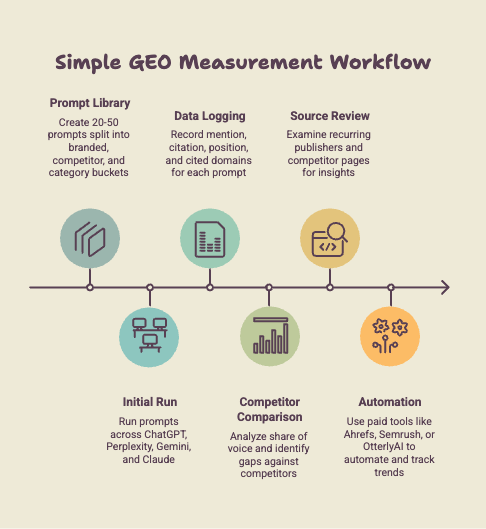
Here’s a simple workflow for your own brand:
- Build a prompt library. Start with 10 to 15 prompts and split them into three buckets: branded, competitor, and category. One suggestion is to use vendor-evaluation style prompts and rerunning them weekly across multiple engines.
- Run the same prompts across ChatGPT, Perplexity, Gemini, and Claude if relevant to your buyers.
- Log four things for each prompt: whether you were mentioned, whether you were cited, where you appeared in the answer, and which other domains were cited.
- Compare against competitors. This is where share of voice becomes useful. If you appear in 20% of category prompts and your top competitor appears in 60%, that gap tells you much more than a single lucky mention.
- Review source patterns. If the same publishers keep showing up, try to win coverage there. If the same competitor page keeps getting cited, study what that page is doing better.
How do you connect GEO to actual business impact?
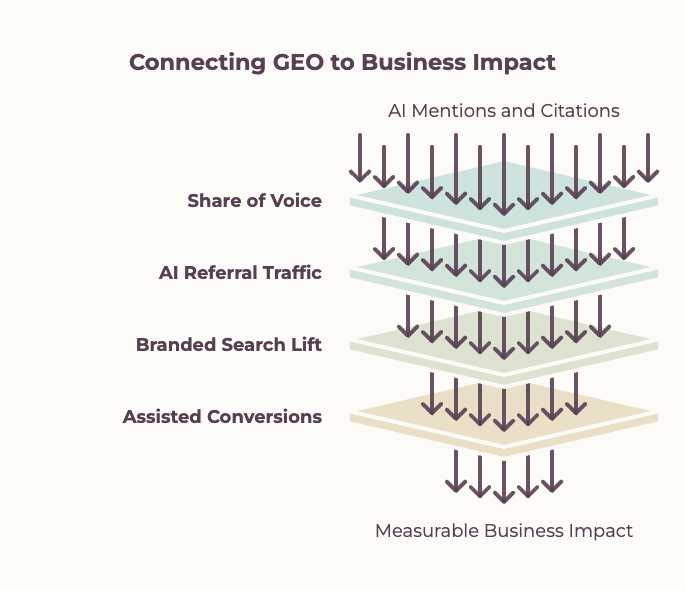
Start with AI referral traffic. GA4 added an AI Assistant channel in May 2026, which makes this easier than it used to be. That gives you a baseline for visits from AI tools that pass referral data.
Still, traffic is only part of the story. Ahrefs found that that AI sends a small share of traffic on average, around 0.1%, but also noted that traffic is not the whole value because AI can drive awareness and assisted conversions before a click ever happens.
I’d track GEO impact in this order:
- mentions and citations across your prompt set
- share of voice against competitors
- AI referral traffic in GA4
- branded search lift over time
- assisted conversions or demo requests from AI traffic where you can measure them
That mix gives you both visibility numbers and business numbers.
Conclusion
The best way to measure generative engine optimization is to stop looking for one ranking number. GEO gets much easier to understand when you track four things together: brand mentions, AI citations, share of voice, and source tracking. Then pair that with AI referral traffic and branded demand so you can see whether visibility is turning into real business impact.
If you want the traditional side of brand tracking too, use Mentionkit. LLM visibility does not exist in a vacuum. Models often reflect what is already being said across the web, and Mentionkit helps you track that conversation across Reddit, X, LinkedIn, and Hackernews.
If you are starting from scratch, build a 20-prompt library, run it once a week for a month, and log the results in one sheet. You will learn very quickly which prompts matter, which competitors keep winning, and which sources AI tools trust in your category.