
Brandwatch pricing can feel hard to pin down because the public site simply does not give you a simple plan table.
If a tool hides the price behind a demo form, the contract usually includes more than alerts. You are probably buying a bigger platform, a sales-led contract, onboarding, support, dashboards, usage limits, and add-ons that may change the final quote.
This guide explains Brandwatch pricing in 2026, what drives the cost, who should still pay for it, and which Brandwatch alternatives make more sense if you mainly need social monitoring, brand tracking, competitor mentions, or lead discovery.
Brandwatch pricing in 2026: what we know
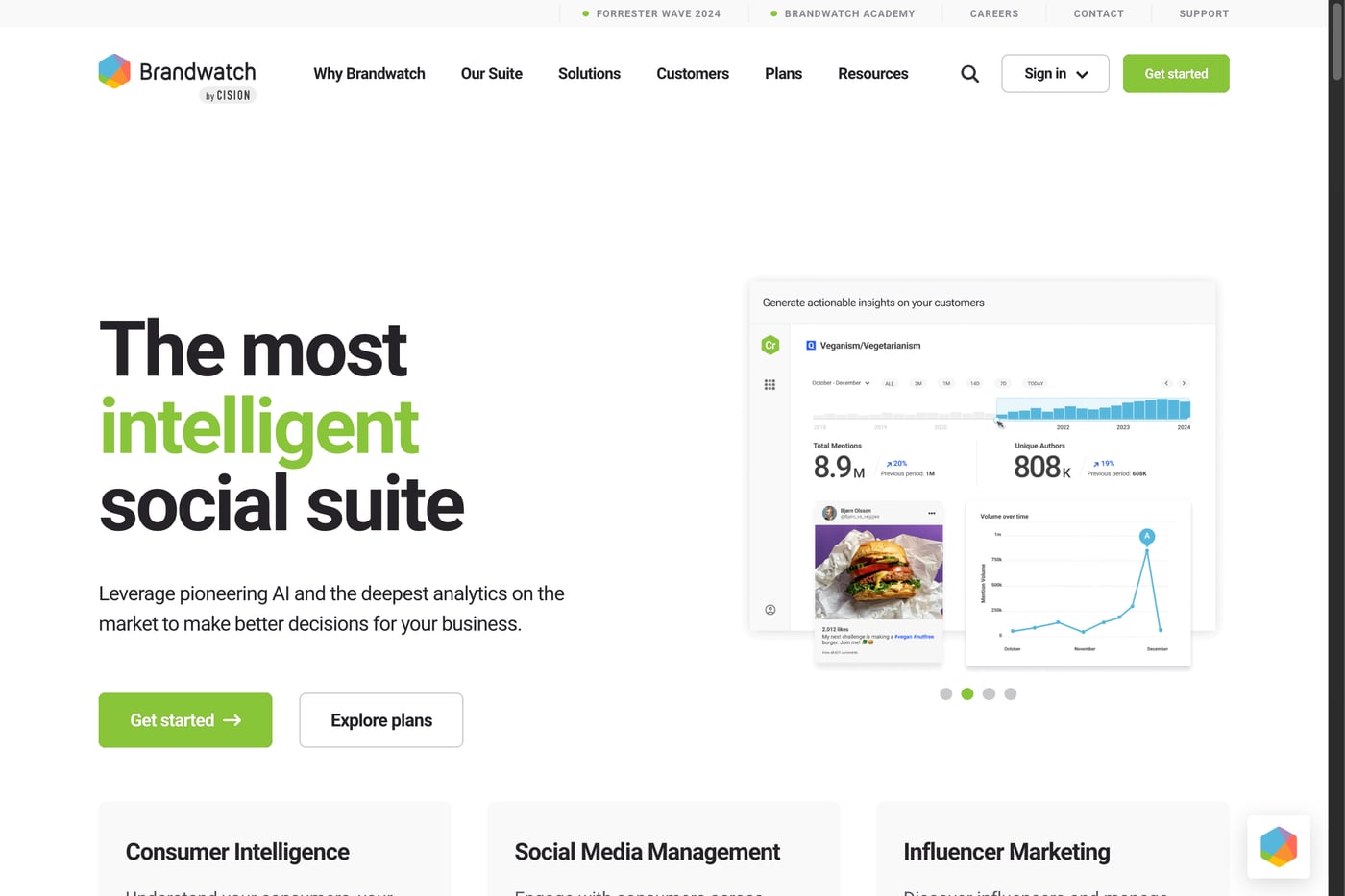
Brandwatch does not publish a normal self-serve price list on its main pricing page. The official Brandwatch plans page says there are standard to enterprise plans across Consumer Intelligence, Social Media Management, Influencer Marketing, Search Intelligence, and Media Intelligence & Insights. The page pushes buyers toward a demo rather than checkout.
On Capterra, the starting price as “Contact vendor for pricing” and says a free trial is not available 😒
There are other clues, though. A UK based G-Cloud listing for Brandwatch shows a unit price of £4,800 a year. Its attached G-Cloud pricing document gives more detail for that procurement channel:
| Brandwatch product area | Public-sector pricing clue | What it means |
|---|---|---|
| Consumer Intelligence, query model | Pro starts at £10,800/year for 5 queries | Listening price can scale with saved search queries |
| Consumer Intelligence, mentions model | Premium starts at £30,600/year for 500K monthly mentions | Higher-volume monitoring moves into larger contracts |
| Social Media Management | Standard £13,800/year, Pro £22,200/year, Premium £39,000/year | Publishing, engagement, listening, and reporting are sold as a suite |
| Add-ons | examples include Vizia, image insights, API rate increases, and extra channels | The quote can grow when you need more than the base package |
Don’t take these literally. Brandwatch’s cost can change by country, featureset, volume, etc.
Other pricing pages can also be useful as benchmarks. TrustRadius lists Brandwatch pricing with a Pro benchmark of $800 and an Enterprise benchmark of $3,000+, but Brandwatch’s own site still points you to a demo for the quote.
If you’re shopping for Brandwatch, budget for an annual contract and expect a sales conversation. If you need a clean monthly price, Brandwatch probably is not the first tool I would shortlist.
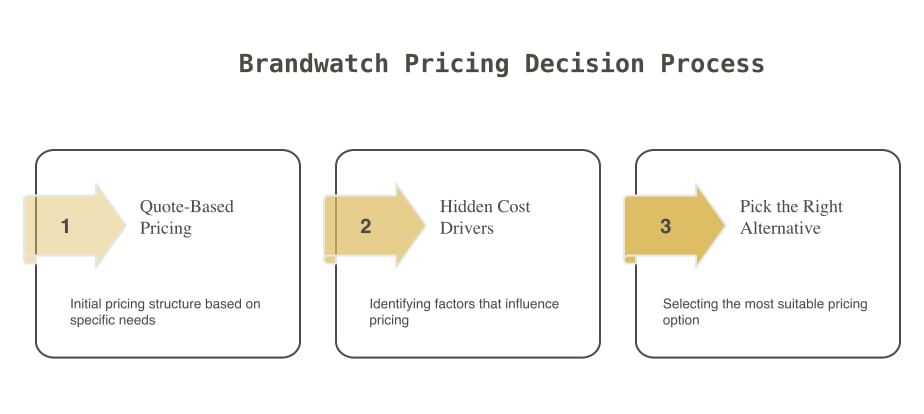
What drives your Brandwatch account price?
The biggest driver might be the product you need.
Brandwatch is a suite. The official plans page separates the product into Consumer Intelligence, Social Media Management, Influencer Marketing, Search Intelligence, and Media Intelligence & Insights.
The second driver is usage.
For Consumer Intelligence, the G-Cloud pricing document shows two pricing models: query-based pricing and mentions-based pricing. Query pricing is based on saved search queries. Mentions pricing is based on the number of unique results collected each month.
The third driver is workflow depth.
Brandwatch makes the most sense when your team needs dashboards, reporting, research depth, stakeholder updates, and deeper social data analysis.G2 Reviewers often praise its data depth and reporting flexibility. The same review pool also includes some issues: learning curve, query setup, manual refinement, and pricing pressure for smaller teams.
This tradeoff is normal for enterprise software. A powerful research platform can be worth it when many people depend on the output. It can feel heavy if your job is much simpler: find the right mention, reply fast, and track what happened.
If you are still sorting the category, start with this guide on what social listening is.
If your use case is brand protection and daily review, this brand mention monitoring workflow is a better first step than booking five demos.
When Brandwatch is worth it, and when it is overkill
Brandwatch is worth it when the buyer needs a serious research and reporting system. If you have analysts building queries, many stakeholders reading dashboards, and a need for historical data, the quote-based pricing makes more sense. It is also easier to justify when listening, publishing, engagement, influencer work, and reporting all need to live in one larger suite.
Brandwatch is overkill when the job is much simpler. If you mainly need to track brand mentions, catch competitor complaints, watch Reddit or X threads, and reply, you may pay for a lot of platform depth you will barely use. The sales process, onboarding, training, and yearly contract can slow you down before you get value out of it.
Most smaller businesses need a social monitoring tool that makes the daily workflow easy: track the right keywords, review the best mentions, reply while the thread is still active, assign follow-up, and report on what was handled. If that is the job, I’d avoid Brandwatch.
Better Brandwatch alternatives
Here are the Brandwatch alternatives I would look at based on the job you need done.
| Tool | Best for | Pricing style | Watch-out |
|---|---|---|---|
| Mentionkit | Lean teams that want social monitoring, lead discovery, and team workflows | Public monthly pricing from $30/month | Built for practical monitoring rather than very large enterprise research |
| Brand24 | Teams that want broad media and brand monitoring with reports | Public pricing from $249/month | Lower plans can feel tight on keywords |
| Awario | Smaller teams that want lower-cost brand monitoring | Public pricing from $49/month | Less depth for advanced reporting and analysis |
| Syften | Community monitoring and alerts | Public pricing from about $29.95/month | Narrower than a full social listening suite |
| Octolens | AI-filtered mentions, API, webhooks, and agent-friendly workflows | Public pricing from $159/month | Can get expensive as volume grows |
1. Mentionkit: best for practical social monitoring and lead discovery
Mentionkit is the Brandwatch alternative I would choose when your goal is to get relevant mentions in one place.
It tracks public mentions across Reddit, X, LinkedIn, TikTok, Bluesky, YouTube, Hacker News, and GitHub. You can track brand keywords, competitors, problem phrases, and buying-intent terms, then review matches in one feed.
Mentionkit’s pricing starts at $30/month for Starter, $60/month for Pro, and $150/month for Agency. API and webhooks are also listed on the pricing page, which helps if you want mention data in your own workflow.
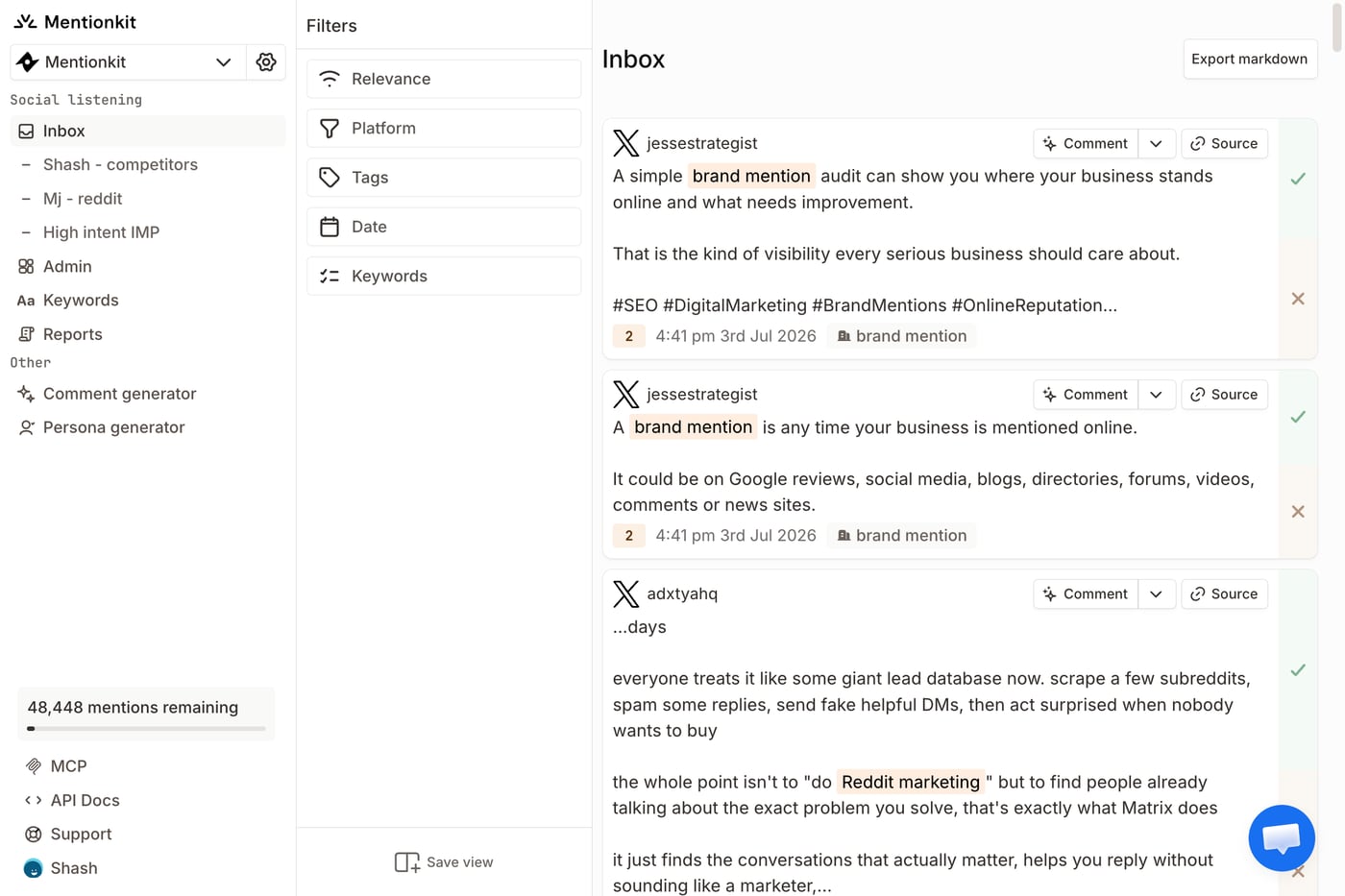
Mentionkit is built around finding mentions, reviewing relevance, drafting replies, assigning ownership, and reporting on what was handled.
If you want a wider tool list, this top social listening tools guide compares Mentionkit, Brandwatch, Syften, Octolens, and other tools.
2. Brand24: best if you want a broader monitoring dashboard with public pricing
Brand24 is a better fit than Brandwatch if you want a known price before talking to sales. It is still not cheap, but the plans are public. Based on our local competitor research, Brand24 starts at $249/month, with higher tiers for more keywords, mentions, and reporting.
Brand24 is good for businesses that want brand monitoring, media monitoring, sentiment, and reports in one place. The tradeoff is that lower plans can be restrictive if you track many keywords.
Read the direct Mentionkit vs Brand24 comparison if you are choosing between broad monitoring and a simpler action workflow.
3. Awario: best lower-cost brand monitoring option
Awario is more accessible for smaller teams. Our competitor notes show plans from $49/month, with higher tiers adding more projects, alerts, mentions, white-label reports, and API access.
It is a good choice if you want basic social listening and brand monitoring without Brandwatch-level pricing. The tradeoff is depth. Reviews often point to sentiment and data quality as areas where users still need to check results manually.
The Mentionkit vs Awario comparison is useful if you care more about buyer-intent mentions and reply workflows than broad mention counts.
4. Syften or Octolens: best if community alerts matter most
Syften and Octolens are closer to lightweight monitoring tools than Brandwatch. They can make sense if your main job is catching mentions across communities and routing them into Slack, email, API, webhooks, or agent workflows.
Syften is more community-alert focused. Octolens is more AI-filtered and workflow/API focused. Both are easier to understand than Brandwatch pricing, but they can still become expensive depending on sources, volume, and add-ons.
Conclusion
Brandwatch pricing is quote-based for a reason. It is built for buyers who need a bigger social suite, deeper research, dashboards, stakeholder reporting, and enterprise support. If that is your world, Brandwatch can be worth a serious demo.
For many SaaS teams, agencies, and lean marketing teams, it is more platform than the job requires.
If your goal is to track public conversations, catch competitor and brand mentions, finding high-intent posts, reply quickly, and show what your team handled, start with a simpler tool.
Mentionkit is built for that path. It gives you a clear social monitoring workflow, public pricing, API and webhook access, and enough team features to move from “we saw a mention” to “someone handled it.”