
Most advice on brand re positioning starts in the wrong place. It starts with identity assets. New logo. New site. New tagline. Maybe a launch video if the budget allows.
That work matters, but it isn’t the work that decides whether repositioning succeeds. Market perception does. If buyers still place you in the same old mental box after the redesign, you haven’t repositioned anything. You’ve just updated packaging.
The teams that handle repositioning well treat it as a response to live market evidence. They watch how buyers describe the problem, which competitors keep showing up in recommendation threads, where trust is breaking down, and which claims no longer sound believable. Then they rebuild the brand around that reality. That’s the difference between a cosmetic rebrand and a move that changes pipeline quality, sales conversations, and category fit.
Rethinking Brand Repositioning Before You Start
The common myth is simple. Brand re positioning is a creative exercise. It isn’t. It’s a strategic correction.
That distinction matters because once a team frames repositioning as a design project, the wrong people drive the process. Creative gets over-weighted, while product, sales, support, and customer research get pulled in too late. The result is familiar. A polished rollout that looks expensive and feels hollow.

What repositioning actually changes
Real repositioning changes how the market answers a few hard questions:
- What category do you belong to
- Who are you for
- Why should buyers believe you now
- Why should someone choose you over the alternatives they already know
If those answers don’t shift, the market doesn’t shift.
This is why the best repositioning work usually starts with uncomfortable evidence. Sales calls where prospects keep comparing you to the wrong vendor. Support tickets that reveal a broken promise. Reddit threads where buyers describe your category in language your homepage never uses. Internal teams often think the problem is visibility. In practice, it’s often interpretation.
Practical rule: If your repositioning brief can be approved without reviewing buyer language, loss reasons, and public conversation data, the brief is too shallow.
There’s also a timing issue. Many companies wait until the gap between internal story and market perception gets painful. That’s late. According to Bynder’s 2026 rebranding statistics roundup, 45% of companies implement rebranding strategies specifically for market repositioning, making it the second most common driver after refreshing outdated images. That tells you repositioning isn’t a niche brand exercise. It’s a mainstream response to changing market conditions.
What works and what doesn’t
What works is a business-first lens.
A strong repositioning effort usually has these traits:
- A specific market trigger such as shifting buyer behavior, stronger competitors, or a message that no longer matches the product.
- A sharp strategic choice about what you’ll emphasize, stop claiming, and deprioritize.
- Evidence from outside the company rather than internal preference alone.
What doesn’t work is easy to spot too:
- Cosmetic updates without strategic sacrifice
- Messaging built around what leadership likes hearing
- Vague goals such as “feel more premium” or “look more modern”
- Trying to appeal to everyone at once
The right starting question
Don’t ask, “How should we refresh the brand?”
Ask, “What does the market currently believe about us that is limiting growth, and what would need to change for that belief to shift?”
That’s the question that makes brand re positioning useful. It forces the team to treat perception as the actual battleground, not aesthetics.
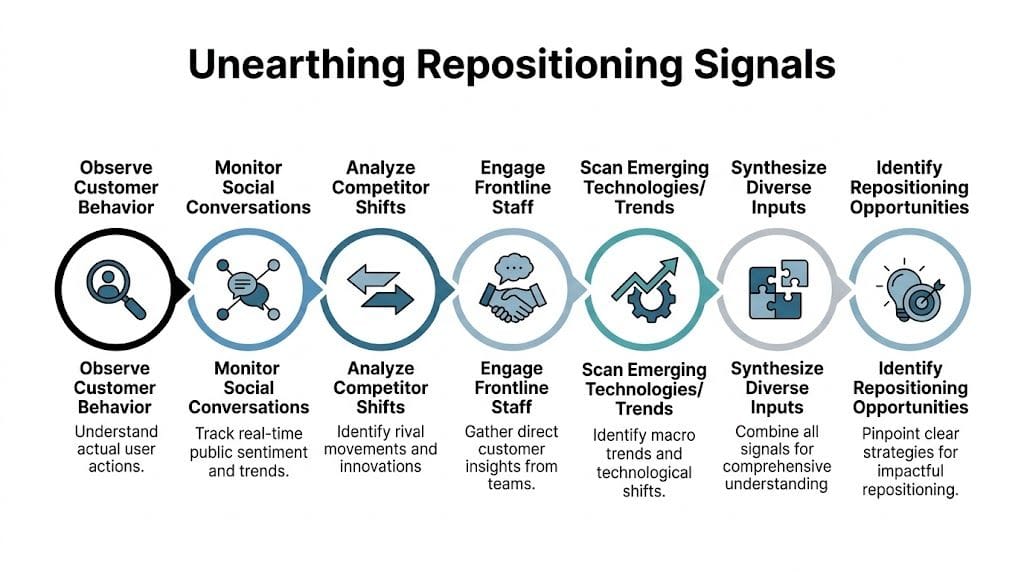
Finding Your Repositioning Signals in the Wild
The fastest way to miss a repositioning opportunity is to rely only on controlled research. Surveys help. Interviews help. Focus groups can help. But buyers often reveal the most useful truth in places where they aren’t being studied.
That means public threads, peer recommendations, complaint posts, product comparisons, implementation debates, and offhand comments from practitioners. The signal isn’t always neat. It’s often messy, repetitive, and easy to dismiss until the pattern becomes obvious.
Where the useful signals usually appear
The most valuable repositioning clues tend to show up in a few recurring places:
-
Comparison threads
Buyers ask for alternatives when the category framing is already in motion. Pay attention to who gets mentioned with you. That’s often more revealing than your formal competitor list. -
Complaint language
Complaints expose the promises buyers think brands in your space should keep. If enough people say a tool is “too complex,” “too enterprise,” or “not reliable enough,” that’s not just feedback on one vendor. It’s a map of category frustration. -
Workaround conversations
When users stitch together spreadsheets, Zapier flows, Slack routines, or internal docs to solve something your category should handle natively, they’re describing unmet value. -
Frontline team notes
Sales, support, onboarding, and community teams hear positioning friction earlier than brand teams do. They know which words confuse buyers and which claims trigger skepticism.
A lot of teams skip this bottom-up work because it feels less formal. That’s a mistake. According to AskAttest’s brand repositioning analysis, existing guides often overlook platform-specific monitoring on Reddit, X, and LinkedIn, even though 94% of consumers favor transparent brands and gaps in audience needs can be identified through mention analysis rather than surveys alone.
How to gather signals without drowning in noise
Don’t monitor everything. Monitor the conversations that reveal intent and interpretation.
Use a simple collection framework:
-
Brand terms
Your company name, product names, and common misspellings. -
Category phrases
The jobs buyers are trying to solve, not just the category labels marketers use. -
Competitor comparisons
”X vs Y,” “alternative to,” “best tool for,” “switching from,” and “recommendation” patterns. -
Problem language
Words buyers use when they’re frustrated, blocked, replacing a tool, or rethinking priorities.
For teams building that monitoring muscle, this guide to brand mention monitoring is a useful operational reference because it forces a practical question: what are you tracking, who owns the review process, and how quickly can the team act on a relevant mention?
Watch for repeated phrasing, not just repeated topics. Repositioning often starts when buyers keep describing the problem in language your brand doesn’t use yet.
How to turn raw mentions into strategic direction
A thread is not a strategy. A pattern is.
Look for clusters like these:
| Signal pattern | What it may mean |
|---|---|
| Buyers compare you to cheaper tools | Your current position may be too generic or under-justified |
| Buyers praise one feature but ignore your core message | Your real wedge may differ from your stated positioning |
| Prospects ask peers to validate claims before buying | Trust is the barrier, not awareness |
| Users describe a niche use case repeatedly | A more focused market position may be stronger than a broad one |
The best repositioning signals are usually hiding in plain sight. They show up before your dashboard catches them and before your quarterly research deck gives them a name.
Mapping Your Current Brand Reality
Before a team writes a new positioning statement, it needs an honest view of the one currently operating in the market. Not the version in the brand book. The version that shows up in buyer conversations, loss reasons, sales friction, and public associations.
That’s where most brand re positioning work gets distorted. Internal teams usually overestimate message clarity and underestimate how fragmented perception has become across channels.

A solid audit doesn’t need to be glamorous. It needs to be complete. According to Doisz on repositioning methodology, a proven methodology for brand repositioning starts with thorough data analysis of current perceptions, and 78% of companies using this approach see engagement increases up to 12 months post-repositioning.
Build the audit from four evidence pools
Teams frequently already have the raw material. They just keep it in separate systems and never force it into one view.
Internal performance data
Start with the basics. Look at win-loss notes, churn reasons, customer support themes, onboarding friction, and objection patterns from sales calls. You’re not hunting for volume alone. You’re looking for repeated interpretation problems.
If prospects keep saying, “We thought you were more for small teams,” or “We didn’t realize you handled enterprise workflows,” that’s positioning evidence.
Structured market input
Sometimes you need direct input in a format you can compare. Well-designed questionnaires remain helpful, especially when pressure-testing perceptions across customer segments. If your team needs a practical model, these survey forms for market research are useful because they show how to capture cleaner feedback without asking vague, leading questions.
External conversation data
Public discourse shows what controlled research often misses. Buyers speak more plainly in peer environments than in moderated sessions. That makes social listening useful before the repositioning, not just after launch.
If you’re evaluating platforms or building your stack, this roundup of top social listening tools for 2026 helps compare approaches to monitoring and workflow, which matters once you move from “interesting mentions” to repeatable team practice.
What to map, specifically
A useful current-state map answers five questions:
- What do buyers think we are
- What do they hire us to do
- What do they distrust
- Who do they compare us to
- Which message associations appear naturally, without us forcing them
This walkthrough is a good primer on how practitioners think about diagnosing perception before changing it.
Audit test: If your sales team, leadership team, and customers would describe your brand in materially different ways, you don’t have a messaging problem alone. You have a positioning gap.
The disconnect that matters most
The sharpest insight in an audit is usually the gap between intended identity and received meaning.
Maybe you say “strategic platform” while buyers see a point solution. Maybe you present as premium while users describe the experience as rigid. Maybe you claim simplicity while implementation threads tell another story. That’s the gap your repositioning has to close.
Without that map, teams build a new story on top of old confusion.
Developing Your New Narrative and Messaging
Once the evidence is clear, the work shifts from diagnosis to construction. At this stage, teams often get tempted to write copy too early. Resist that. Messaging should come after the strategic choices are made, not instead of them.
A strong repositioning narrative does three things at once. It clarifies who the brand is for, sharpens the value promise, and gives buyers believable reasons to update their assumptions. If one of those pieces is weak, the story won’t hold.

Start with the narrative spine
Before you write headlines, define the core argument.
I like to pressure-test it with four prompts:
-
Old belief
What does the market currently believe that is no longer useful to you? -
New frame
What new interpretation should replace it? -
Proof
What product truth, customer experience, or market behavior makes that new frame credible? -
Voice
What tone will carry this position in a way that sounds distinctive and repeatable?
This prevents the usual failure mode where messaging gets more polished but not more pointed.
Old Spice got the message and the frame right
Old Spice remains one of the clearest repositioning examples because the change wasn’t just creative. It changed the cultural meaning of the brand.
The old perception was stale and dated. The new frame was playful, modern, and self-aware. The campaign didn’t politely update the brand. It rewired how people talked about it. According to Amra & Elma’s rebranding campaign statistics roundup, Old Spice’s 2010 repositioning campaign boosted body wash sales by 107% in six months and achieved 200%+ cumulative revenue growth from 2010-2025, outperforming 94% of comparable CPG rebrands, per a 2026 Harvard Business School retrospective.
That result came from alignment across message, product, and channel. The humor was memorable. The product and packaging supported the shift. Digital execution amplified the repositioning instead of merely announcing it.
A new message only sticks when the experience around it gives buyers evidence to repeat it in their own words.
Build a message house your team can actually use
Many teams don’t need more copy. They need a clearer message hierarchy.
A practical framework looks like this:
| Layer | What it should answer |
|---|---|
| Positioning statement | What market space are we trying to occupy |
| Value proposition | Why this matters to the target buyer |
| Proof points | Why the claim is credible now |
| Audience adaptations | How the core message changes by segment |
| Voice rules | How the brand should sound under pressure |
What strong messaging usually does
Good repositioning language tends to have a few qualities in common:
-
It narrows before it expands
Broad language feels safe and usually lands weak. -
It uses buyer vocabulary
Not every exact phrase from the field belongs on the homepage, but the market’s language should shape the message architecture. -
It removes claims you can’t support
A tighter story with fewer promises is often more persuasive than a sprawling one. -
It travels across functions
Sales decks, onboarding scripts, paid ads, founder interviews, support macros, and job descriptions should all sound like the same company.
The brands that get this right don’t just sound better. They become easier to understand, easier to recommend, and easier for internal teams to represent consistently.
Your Repositioning Go-to-Market Checklist
A repositioning launch fails in mundane ways. Not because the strategy was necessarily wrong, but because execution got fragmented. One team updates the homepage. Another keeps pitching the old story. Sales decks lag behind. Customer success doesn’t know how to explain the shift. Paid media starts testing language that product can’t support.
That kind of inconsistency is why rollout needs operational discipline, not just enthusiasm.
Choose the rollout style before you choose the date
There are two basic launch patterns.
Big bang launches work when the old position is actively hurting the business or when the new story requires a clean break. This approach creates clarity fast, but it raises the execution burden. Every customer-facing touchpoint needs to be ready.
Phased rollouts are usually better when the company has multiple segments, long sales cycles, channel partners, or a large installed base. The team can test message adoption, train internal stakeholders, and retire old assets in sequence.
Neither option is automatically smarter. The right call depends on how much confusion the current position is creating and how much internal coordination your team can manage.
Repositioning Project Plan
| Phase | Key Activities | Primary Owner (In-House) | Primary Owner (Agency) | Timeline |
|---|---|---|---|---|
| Strategy lock | Finalize positioning, audience priorities, proof points, messaging guardrails | CMO or Head of Marketing | Brand strategist | Pre-launch |
| Internal alignment | Train sales, support, CS, recruiting, leadership; update scripts and FAQs | Revenue leadership and Marketing ops | Enablement partner | Pre-launch |
| Asset rebuild | Update website, decks, ad copy, sales collateral, product marketing materials, email templates | Brand team and Product marketing | Creative and content teams | Pre-launch to launch |
| Launch communications | Customer emails, PR prep, founder posts, social copy, partner messaging | Communications lead | PR or content agency | Launch window |
| Field activation | Roll out to paid channels, outbound teams, events, webinars, community touchpoints | Demand gen and Sales leaders | Media or growth agency | Launch window |
| Feedback loop | Review objections, public reactions, call recordings, and adoption gaps | Marketing ops and Product marketing | Research or strategy support | Post-launch |
The checklist teams actually need
Use this as a working list, not a ceremonial one.
-
Solidify the essentials Decide which claims, terms, and comparisons the company will use and which ones are being retired.
-
Train every customer-facing team
Repositioning breaks when support and sales improvise different versions of the story. -
Update hidden assets
Proposal templates, demo scripts, marketplace listings, partner docs, recruiting pages, and auto-responses often stay stale long after the homepage changes. -
Create objection guidance
Buyers will ask why the brand changed, what it means, and whether the product changed with it. Prepare direct answers. -
Assign ownership clearly
Repositioning creates messy overlap between brand, product marketing, demand gen, sales, and agency partners. Name one owner for each deliverable.
For B2B teams, this matters even more because repositioning touches category creation, outbound language, pipeline quality, and campaign targeting at the same time. This practical overview of B2B demand generation strategies is helpful when you’re translating the new position into actual acquisition programs instead of stopping at brand language.
The fastest way to weaken a repositioning launch is to let old and new messaging coexist for too long without rules.
What usually goes wrong
The failure pattern is predictable:
- leadership signs off but frontline teams don’t buy in
- the website changes before the deck ecosystem does
- agencies get the new story but internal teams keep using the old one
- product limitations undercut the new promise
- no one owns post-launch cleanup
A good rollout plan removes those gaps before launch day, not after.
Measuring Repositioning ROI and Next Steps
If you only measure awareness after a repositioning, you’ll miss whether it changed anything that matters. Awareness can rise while conversion quality stays flat. Sentiment can look positive while sales calls get harder. The point of repositioning is not just to be noticed differently. It’s to be chosen differently.
That’s why measurement has to connect perception, behavior, and business outcomes.
What to track after launch
Start with the metrics closest to commercial impact:
-
Lead quality
Are the right accounts entering the pipeline more often? -
Sales velocity
Are opportunities moving with less friction because the value story is clearer? -
Win-loss language
Are buyers describing you in the new terms you intended? -
Customer fit
Are new customers better aligned with the promise you’re making?
Those metrics tell you whether the repositioning is improving decision quality, not just campaign reach.
Add a live perception layer
At this stage, many teams go blind. They launch, look at traffic and branded search, then wait for quarterly reviews. That lag is expensive.
According to Dash’s guide to brand repositioning execution, a frequent unaddressed question is how to measure ROI and avoid execution pitfalls, since multi-channel consistency issues doom 60% of repositioning efforts. The same source notes that integrating real-time alerts from social platforms helps track post-repositioning sentiment and close feedback loops.
That matters because post-launch conversation tells you whether the new position is sticking. Are buyers repeating your new framing on Reddit or LinkedIn? Are competitors changing how they respond to you? Are customers confused by the shift, or are they adopting the language naturally?
Build a review rhythm that forces action
A practical review cadence usually includes:
| Review area | What to examine |
|---|---|
| Commercial outcomes | lead quality, deal progression, objection trends |
| Message adoption | website behavior, sales call language, content performance |
| Market reaction | public mentions, sentiment themes, competitor comparison shifts |
| Execution drift | old assets, off-brand copy, mixed internal usage |
If your team wants a stronger layer of interpretation on top of that reporting, tools built for AI marketing analytics can help connect campaign data, message performance, and decision support without reducing the analysis to vanity metrics.
Repositioning isn’t finished when the brand team launches it. It’s finished when the market starts using your new frame without being coached.
What to do when the signal is mixed
Mixed results are normal. The mistake is treating them as proof the strategy failed or succeeded too early.
If sentiment improves but deal quality doesn’t, the message may be resonating with the wrong audience. If sales likes the new position but public conversation stays anchored in the old one, your amplification or proof may be weak. If some channels adopt the new story faster than others, tighten governance before inconsistency hardens.
The best teams treat repositioning as a managed transition. They keep listening, tighten weak claims, retire language that isn’t landing, and feed what they’re learning back into product marketing, demand gen, and sales enablement.
If your team wants a faster way to spot the buyer conversations that should shape positioning before launch, and the sentiment shifts that matter after it, Mentionkit helps you monitor high-intent discussions across Reddit, X, LinkedIn, and Hacker News so you can act on live market signals instead of relying on stale assumptions.