- 1. Social Listening & Sentiment Analysis
- 2. Community Research & Forum Analysis
- 3. Competitive Analysis & Benchmarking
- 4. Lead Generation & Intent Mining
- 5. Customer Interviews, Journey Mapping & User Testing
- 6. Survey & Questionnaire Research
- 7. Keyword & Search Trend Analysis
- 8. Win/Loss Analysis & Sales Feedback
- 8 Market Research Types Comparison
- Choosing the Right Research Type for Your Goal
Most advice about market research is stuck in the old model. Run a quarterly survey. book a few interviews. package the findings into a slide deck. revisit it six months later. That’s fine if you’re a large company with time to waste.
It’s a bad operating system for modern SaaS, agency, and ecommerce teams.
Market research isn’t a one-off project anymore. It’s an active process for spotting demand, hearing objections before sales does, tracking competitor weakness, and finding prospects while they’re still describing the problem in public. That shift matters because buyers don’t wait for your research cycle. They ask peers for recommendations on Reddit, compare tools on LinkedIn, complain on X, and reveal buying criteria in review sites and search queries long before they ever fill out a demo form.
The old advice also underrates the role of data. Hanover Research notes that data analytics is now used by about 70% of companies in at least one market research project. That tells you where the discipline is going. Less guesswork. More live signals.
The most useful market research types in 2026 blend structured methods like surveys and interviews with continuous monitoring across communities, search, and sales conversations. That’s where tools like Mentionkit fit. They connect research to action by surfacing real conversations with commercial intent.
Here are eight market research types that help you grow.
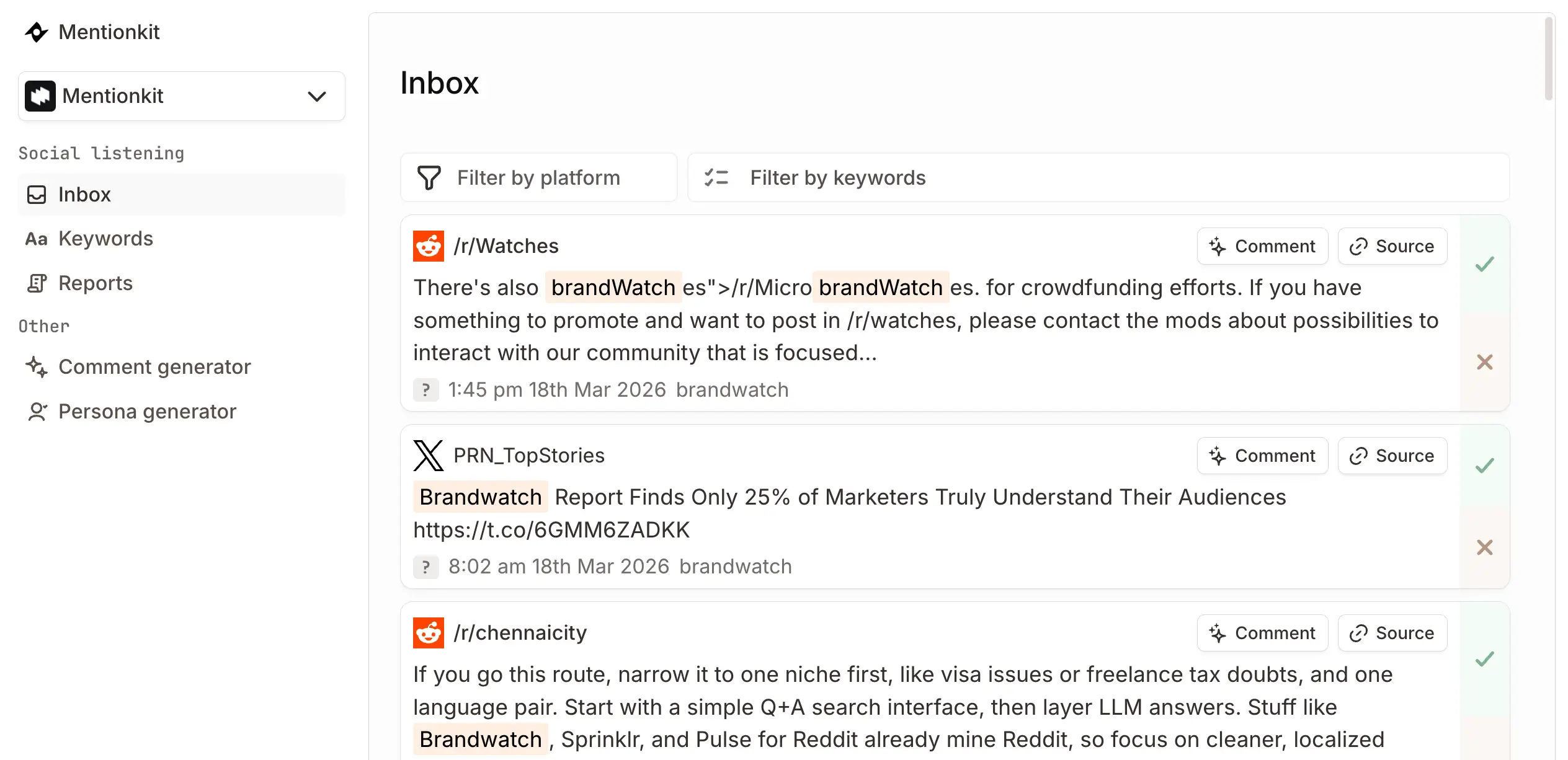
1. Social Listening & Sentiment Analysis
Social listening is one of the few research methods that gets better when you stop treating it like brand vanity monitoring. Counting mentions is easy. Learning why people compare you to a competitor, what language they use when they describe the problem, and which posts signal buying intent is where the value sits.
Used properly, social listening is a hybrid research type. You get quantitative patterns from repeated keywords, engagement, and mention frequency. You also get qualitative context from the post itself, the replies, and the way buyers frame urgency. That mix matters because Drive Research’s overview of tech market research argues for combining qualitative and quantitative methods, with data quality as the deciding factor in whether findings are useful.
Mentionkit is built for that active version of social listening. It tracks conversations on Reddit, X, LinkedIn, and Hacker News so teams can spot recommendation requests, competitor comparisons, and category discussions instead of just broad brand chatter. If you’re setting up your workflow, start with a tighter brand mention monitoring process before you expand into wider category tracking.
Where teams get it wrong
A lot of teams monitor their own name and call it research. That’s just inbox management.
Better setups usually include:
- Category keywords: Track the problem space, not just your brand.
- Competitor names: Buyers often reveal your positioning in comparison posts.
- Urgency phrases: Words like “need,” “switching,” “looking for,” and “alternative” change the priority of a mention.
- Community context: A complaint on Reddit and a product comparison on LinkedIn mean different things.
Practical rule: If your social listening dashboard can’t tell sales who to talk to today, it’s not finished.
Hootsuite, Brandwatch, and Sprout Social are useful for broad monitoring and response workflows. Mentionkit is stronger when the job is finding high-intent conversations fast and routing them into outreach.
2. Community Research & Forum Analysis
If your buyers spend time in niche communities, forum analysis will often tell you more than a polished survey ever will. People speak differently when they aren’t being asked questions by a researcher. They complain more directly. They compare tools more openly. They explain constraints that never show up in a generic persona doc.
That’s why community research deserves its own place among modern market research types. Reddit threads, Slack groups, Product Hunt comments, Dev.to discussions, and Hacker News posts often expose the gap between what companies say matters and what buyers care about.
What to look for inside communities
The best signal isn’t a single viral thread. It’s repetition. When the same question keeps showing up in different forms, you’ve found a demand pattern.
Look for these:
- Recurring questions: These become content topics, product FAQs, and sales enablement material.
- Comparison language: “X vs Y,” “alternative to,” and “what are you using for” tell you where decisions are happening.
- Workarounds: When people stitch together three tools to solve one problem, there’s usually product opportunity.
- Native wording: Community language sharpens your homepage copy far better than brainstormed messaging.
Mentionkit helps here because it can watch specific communities and keywords continuously. For Reddit-heavy research, a dedicated system for Reddit keyword alerts is far more useful than manually checking subreddits when you remember.
Community research works best when you observe first and pitch later.
A founder selling to developers should read the threads where developers complain about deployment friction. An agency selling lead gen services should watch where founders ask peers what’s working now. That kind of observation gives you positioning, objections, and lead opportunities in one stream.
The trade-off is bias. Communities overrepresent vocal users. You shouldn’t treat one subreddit as the whole market. But if you ignore communities entirely, you miss the most candid version of the market.
3. Competitive Analysis & Benchmarking
Most competitive analysis is lazy. Teams build a spreadsheet of features, pricing tiers, and homepage headlines, then call it insight. That’s not enough. Buyers don’t choose products from feature grids. They choose from perceived fit, trust, timing, and how clearly one option solves the problem in front of them.
Useful competitive research combines static analysis with live market feedback. Review sites like G2 and Capterra can show recurring praise and complaints. Semrush and Similarweb can reveal traffic and search positioning patterns at a directional level. Social listening adds the part those tools miss. It captures how prospects talk about your competitors in public, in their own words, while evaluating options.
Build a better competitor file
A practical competitor file should include more than product specs.
- Positioning snapshot: What promise do they lead with?
- Audience focus: Who are they clearly trying to win?
- Common objections: What do users dislike or struggle with?
- Comparison triggers: In what situations do buyers bring them up?
- Message changes: Did they recently shift copy, packaging, or launch language?
Savanta’s overview of technology market research highlights competitor product analysis, patent research, and financial reports as part of the research mix, while noting that survey-derived data can help optimize outreach to specific customer segments. That’s the right framing. Competitive analysis should inform go-to-market, not just satisfy curiosity.
A good example is tracking competitor mentions on Reddit or X after a product update. You’ll often see confusion, pricing frustration, onboarding complaints, or praise for a feature your team has undervalued. That’s benchmark data in plain English.
Don’t benchmark only what competitors say about themselves. Benchmark what customers repeat about them.
The trade-off is maintenance. A competitor file goes stale fast. If nobody owns updates, it turns into a museum of outdated assumptions.
4. Lead Generation & Intent Mining
At this point, market research ceases to be solely a reporting function and begins producing pipeline.
Intent mining means identifying people and accounts that are actively signaling a need. Sometimes that signal is explicit, like “what’s the best tool for X?” Sometimes it’s indirect, like a complaint about a broken workflow, a post asking for alternatives, or a hiring move that suggests a team is investing in a category.
A lot of demand gen teams still separate research from prospecting. They shouldn’t. The same signals that tell you what the market wants can also tell you who wants it right now.
Signals worth acting on
Not all intent is equal. Some posts are curiosity. Some are purchase motion.
Prioritize signals like these:
- Recommendation requests: “What do you recommend for…”
- Replacement language: “Switching from,” “leaving,” or “alternative to”
- Time pressure: “Need this soon,” “by next week,” or “before launch”
- Multi-tool evaluation: When buyers list several options, they’re already in comparison mode
Mentionkit is useful here because it filters public conversations for relevance and gives teams a cleaner queue of opportunities to review. If your team wants a practical playbook, this guide to lead generation from social media maps the outreach side of the process.
The trap is over-automation. A raw feed of keyword matches creates noise and pushes teams toward robotic replies. Strong intent mining needs filtering, context review, and human outreach that responds to the exact problem the buyer described.
ZoomInfo, 6sense, Clearbit, and Terminus can help with account and firmographic intent from different angles. Social intent adds something those platforms often lack. It catches the moment a buyer says the quiet part out loud in public.
5. Customer Interviews, Journey Mapping & User Testing
Interviews still matter. They just shouldn’t happen in isolation.
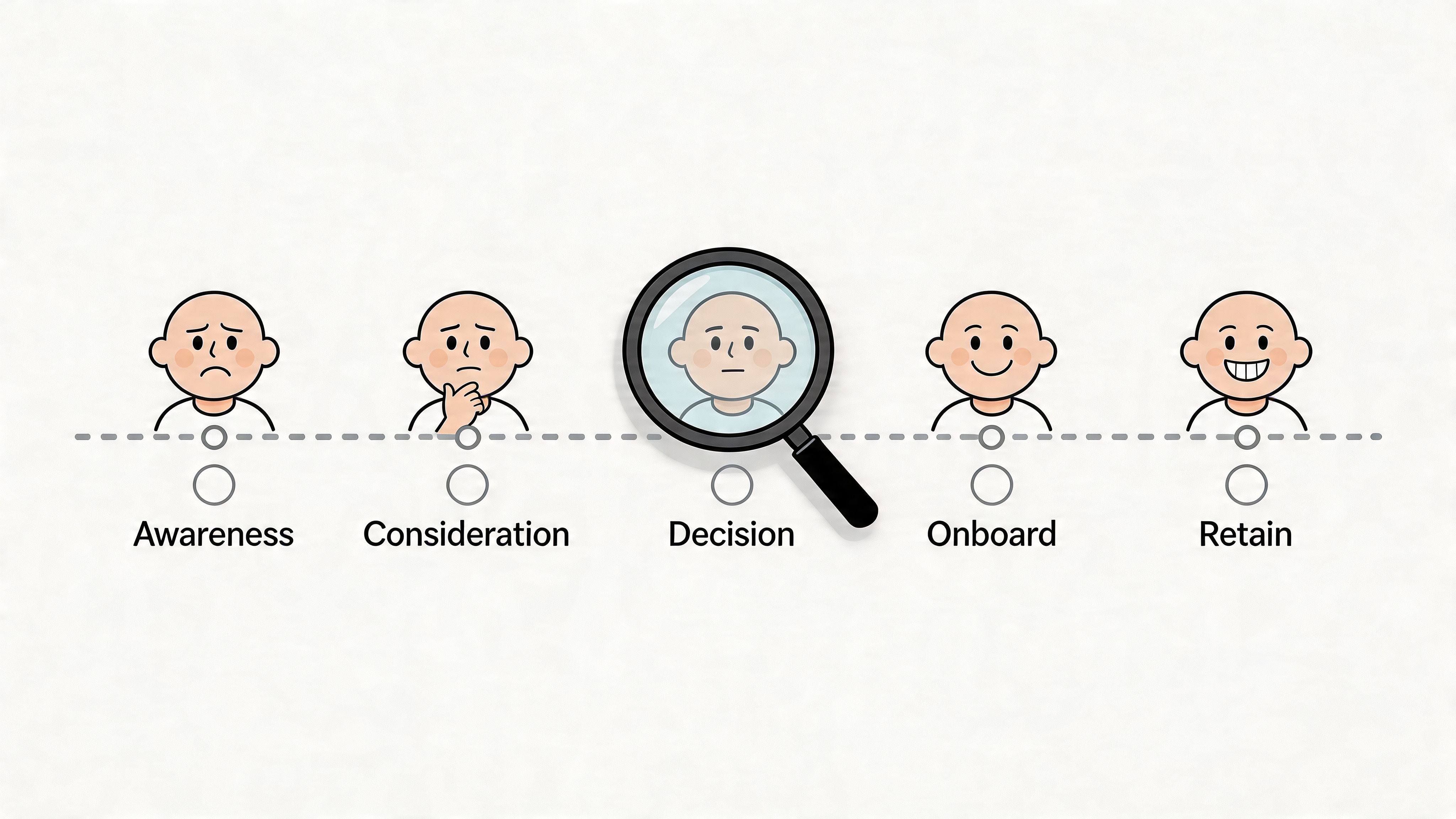
When teams run customer interviews without behavioral data, they get polished narratives. When they rely only on product analytics, they get behavior without motive. Journey mapping and user testing close that gap. Together, these methods show what users do, why they do it, and where the buying or usage experience breaks.
Use social listening to recruit better interview candidates. People already discussing your category, comparing tools, or wrestling with a problem usually give sharper interviews than generic list-based recruits because they’re close to the decision.
Here’s the visual teams should build and revisit:
What this combination uncovers
Interviews are best for motivations, internal politics, and purchase criteria. Journey maps are best for seeing friction across stages. User testing is best for catching the practical failures people rarely remember to mention later.
A strong workflow might look like this:
- Recruit from active demand: Pull candidates from recent social mentions, trial users, and churned accounts.
- Interview across stages: Talk to prospects, new customers, long-term customers, and lost deals separately.
- Watch real behavior: Use tools like UserTesting, Maze, or live screen shares to see confusion in context.
- Map moments that matter: Pricing page visits, demo requests, stakeholder handoff, onboarding, and first value are the big ones.
Slack, Figma, Intercom, and Basecamp have all built reputations for listening closely to users and refining around workflows instead of assumptions. For SaaS teams, that’s still the winning habit.
One caution. Journey maps become fiction when teams update them once a year. Buying behavior changes faster than that, especially in competitive categories.
This walkthrough is a useful complement before you formalize the map:
The best interview note is the sentence a prospect uses to explain why they almost bought something else.
6. Survey & Questionnaire Research
Surveys are still the workhorse of quantitative research. They’re not glamorous, but they’re hard to replace when you need structured feedback from a larger group and need to validate whether a pattern is broad or just loud.
That staying power shows up clearly in adoption. Statista reports that online surveys were used by 85% of market researchers worldwide in 2022 as their primary traditional quantitative method. Surveys dominate because they scale, they’re relatively fast to deploy, and they’re good at measuring awareness, satisfaction, preferences, and segmentation.
What surveys do well, and where they fail
Surveys are great for validation. They’re weaker for discovery.
Use them when you need to answer questions like:
- Preference checks: Which message or feature matters more?
- Segment differences: Do founders and operators evaluate the product differently?
- Satisfaction patterns: Where do ratings break by customer type or use case?
- Pricing reactions: Which concerns show up most often when price enters the conversation?
Tools like SurveyMonkey, Typeform, and Qualtrics make execution straightforward. The hard part is writing questions that don’t bias the answer. Short surveys with clear wording outperform bloated questionnaires almost every time.
A useful modern pattern is to use social listening first, then survey second. Pull language from actual public conversations, turn it into answer options, and validate whether the themes hold across your target audience. That’s a stronger sequence than brainstorming survey questions in a conference room.
The trade-off is false confidence. Survey charts look authoritative even when the questions were vague, the sample was skewed, or the answer options forced a clean result out of a messy reality. Good survey research depends less on the tool and more on disciplined design.
7. Keyword & Search Trend Analysis
Search data is one of the cleanest expressions of market demand because people type what they want when they think nobody is watching. That makes keyword research one of the most practical market research types for content, positioning, product naming, and category tracking.
Google Trends helps spot directional changes in interest. Ahrefs and Semrush help compare keywords, ranking difficulty, and topic clusters. AnswerThePublic is useful when you need raw question framing rather than polished SEO reports. If you’re comparing platforms, this roundup of the best keyword research tools gives a decent orientation.
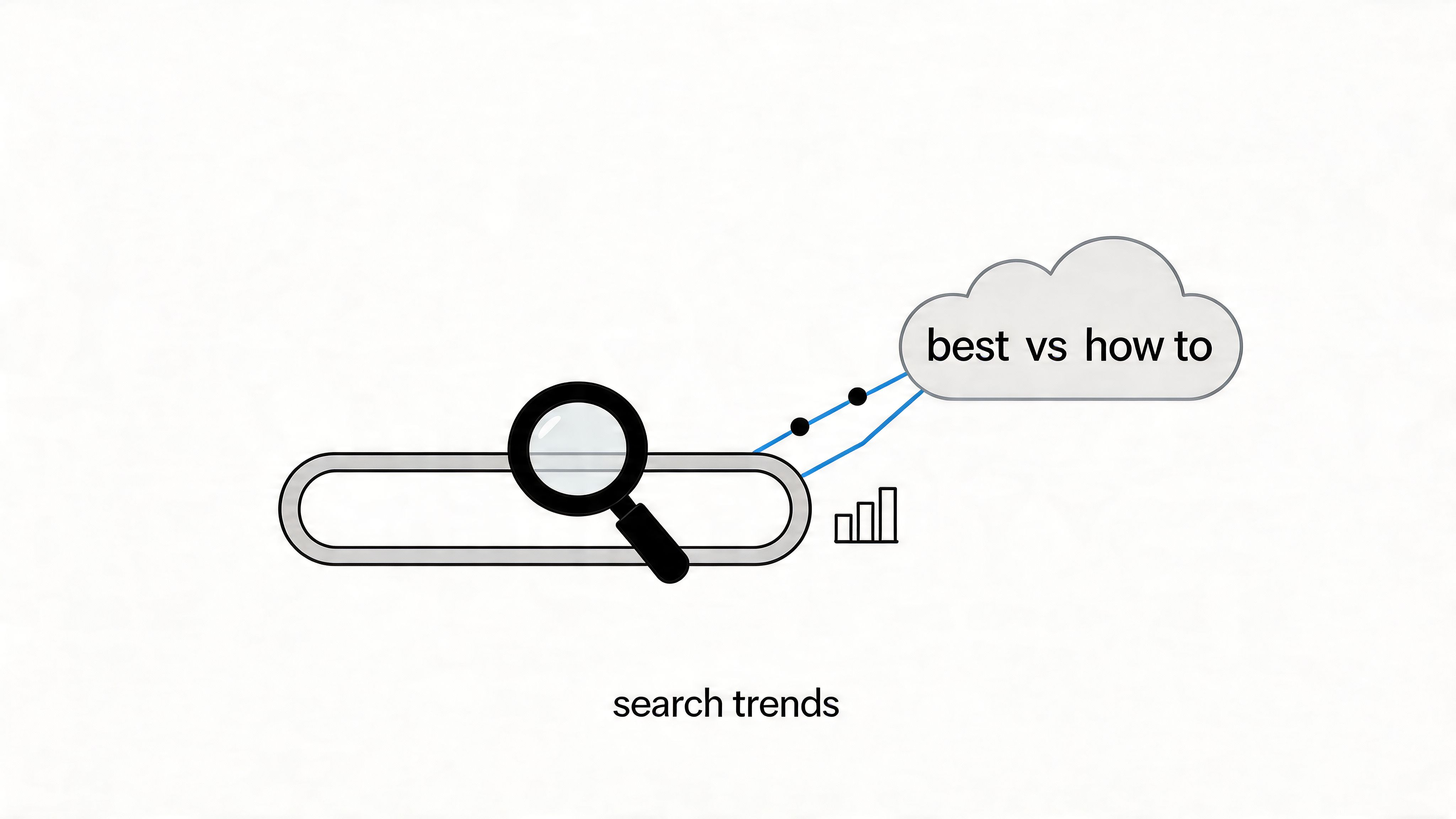
Search tells you demand. Conversation tells you meaning.
Often, teams miss the bigger picture. Search volume can tell you that people are looking for “social listening tool” or “alternative to X.” It can’t fully tell you what triggered that search, what trade-offs matter most, or whether the user is researching casually or buying soon.
That’s why pairing search analysis with social listening works so well. Search gives you structured intent. Conversation gives you context.
Try this combination:
- Track category terms: Understand how the market names the problem.
- Watch comparison queries: “vs” and “alternative” terms usually signal evaluation.
- Inspect SERPs manually: The search results page tells you how the market is currently framed.
- Cross-check language in communities: If search says one thing and forums say another, your messaging needs both.
The downside is that search tools can push teams toward SEO tunnel vision. You start writing for keywords instead of buyers. The better approach is to use search trends as one demand signal, then pressure-test them against interviews, community language, and sales conversations.
8. Win/Loss Analysis & Sales Feedback
If you want the fastest path to better positioning, listen to deals you nearly had.
Win/loss analysis forces honesty. It reveals where your messaging broke, what competitor showed up late and still won, which feature became a veto point, and what buyers actually meant when they said “price.” Sales feedback adds daily market texture because reps hear objections, urgency, internal politics, and hesitation in real time.
What to ask after the deal closes
Teams usually ask too few questions and too late. By then, everyone has rewritten the story.
A stronger approach is to ask:
- Decision criteria: What mattered most in the final choice?
- Competitive set: Which vendors made the shortlist?
- Objections: What almost killed the deal?
- Missing proof: What did the buyer need but never get?
- Counterfactuals: What would have changed the outcome?
Tools like Gong help analyze call patterns and objections. Gainsight and HubSpot can support broader feedback loops. Mentionkit adds another useful layer by showing what prospects and customers say in public about your brand and your competitors before and after decisions.
This method also keeps research grounded. Product teams often think losses come from missing features. Sales often thinks losses come from pricing. Buyers may tell you the actual issue was implementation risk, weak differentiation, or a lack of confidence in support.
Lost deals are research interviews you already paid for. Treat them that way.
The weakness here is internal bias. Reps can misread what happened. Founders can hear only the feedback that confirms their beliefs. A simple interview template and consistent review process does a lot to reduce that problem.
8 Market Research Types Comparison
| Method | 🔄 Implementation complexity | ⚡ Resources & speed | 📊 Expected outcomes | 💡 Ideal use cases | ⭐ Key advantages |
|---|---|---|---|---|---|
| Social Listening & Sentiment Analysis | Medium, requires integrations, NLP tuning | High tooling + near‑real‑time monitoring; moderate analyst time | Ongoing sentiment trends, high‑intent mentions, competitive signals | Brand monitoring, real‑time engagement, campaign tracking | Captures unsolicited feedback; early trend & lead detection |
| Community Research & Forum Analysis | Medium–High, requires relationship building and qualitative analysis | Low tech, high analyst/time investment; slower scaling | Deep language patterns, influencers, niche pain points | B2B SaaS, developer tools, niche product positioning | Reveals authentic terminology and advocates; strong qualitative depth |
| Competitive Analysis & Benchmarking | Medium, structured research and data aggregation | Moderate tools/subscriptions; periodic updates | Feature/pricing benchmarks, market gaps, positioning insights | Product strategy, pricing decisions, go‑to‑market planning | Clarifies differentiation; informs roadmap and messaging |
| Lead Generation & Intent Mining | High, needs accurate intent models and fast workflows | High tooling + rapid response required; real‑time alerts critical | Qualified warm leads, higher conversion, shorter sales cycles | ABM, B2B sales outreach, demand capture at decision moment | Targets buyers mid‑decision; yields high conversion potential |
| Customer Interviews, Journey Mapping & User Testing | High, skilled moderators and synthesis work | Resource‑heavy and time‑consuming; low scalability | Rich qualitative context, UX fixes, validated assumptions | Product discovery, UX improvement, deep customer understanding | Uncovers hidden needs; builds empathy and precise messaging |
| Survey & Questionnaire Research | Low–Medium, careful design and statistical analysis | Moderate tools; fast to collect large samples with recruitment | Quantitative validation, segmentation, trend measures | Hypothesis testing, NPS, market sizing, comparative studies | Scalable, statistically defensible, repeatable results |
| Keyword & Search Trend Analysis | Low–Medium, tool‑driven, routine workflows | Tool subscriptions; quick turnaround for insights | Demand metrics, trending queries, SEO priorities | Content strategy, SEO, identifying search intent shifts | Quantifies demand and finds low‑competition keywords |
| Win/Loss Analysis & Sales Feedback | Medium, structured interviews and synthesis | Moderate coordination with sales; periodic cadence | Real reasons for wins/losses, objection patterns, messaging impact | Sales enablement, pitch refinement, competitive response | Actionable frontline insights; improves objections handling |
Choosing the Right Research Type for Your Goal
You don’t need all eight market research types running at full strength on day one. You need the right method for the question in front of you.
If leads are the problem, social listening and intent mining usually deserve priority. They help you find active conversations, identify urgency, and reach buyers while they’re still evaluating options in public. That’s especially useful for SaaS founders, agencies, and demand gen teams that can’t afford a slow research cycle.
If product direction is the problem, customer interviews, journey mapping, and user testing should move to the top of the stack. Those methods uncover friction, expose buying criteria, and show where your assumptions fail in practice. They also keep teams from overbuilding features no one values.
If alignment is the problem, surveys help validate what’s broad versus what’s anecdotal. They’re useful when leadership needs structured evidence before making a positioning, pricing, or segmentation call. If competitive pressure is the problem, benchmarking and win/loss analysis will usually reveal the gap faster than another brainstorm session.
The bigger point is this. Research works best as a system, not a campaign. Search trends show what people are looking for. Communities show how they talk. Social listening shows what they reveal spontaneously. Interviews explain why. Surveys validate patterns at scale. Sales feedback tells you what happened when money was on the table.
That’s the operating model that fits modern growth teams. Continuous signals, tighter loops, and faster response.
A practical starting point looks like this:
- Need immediate pipeline: Start with social listening and intent mining.
- Need better messaging: Add community research and win/loss interviews.
- Need product clarity: Run interviews, user tests, and journey mapping.
- Need broader validation: Use surveys after you’ve identified the core themes.
- Need category direction: Layer in search and keyword trend analysis.
If you want a broader framework for how these approaches fit together, this guide to essential types of research methods is a helpful companion.
The teams that get the most value from market research types don’t chase perfect coverage. They build a repeatable loop. Listen continuously. validate selectively. update assumptions fast. act while the signal is still fresh.
That’s what turns research from an occasional report into a real growth advantage.
Mentionkit helps turn market research into an everyday growth workflow. You can monitor high-intent conversations across Reddit, X, LinkedIn, and Hacker News, score relevance, route mentions to the right teammate, and respond while prospects are still asking for recommendations or comparing options. If you want a faster way to connect research, competitive insight, and lead generation, Mentionkit is built for that job.