
Boolean filters include or exclude social mentions based on words you choose.
Before AI filtering, you had to write queries like this to track Apple the tech company. It requires apple in the title and at least one listed tech term. A relevant post without those exact terms will be missed.
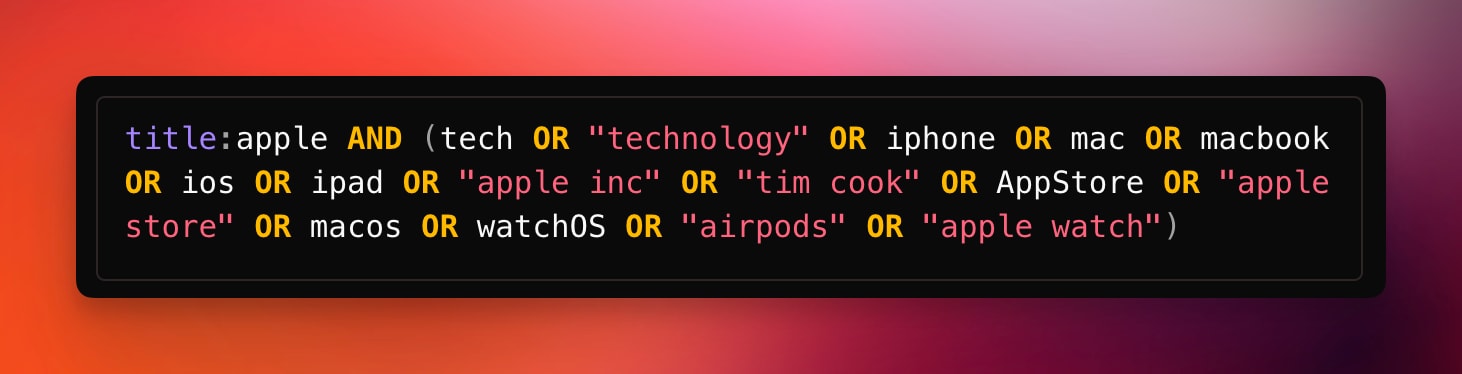
Here is why I think Boolean search is completely outdated for social listening, and how to check whether AI filtering works for your brand.
Why Boolean search is outdated for social listening
Boolean search include/exclude based on rules. For a fictional software brand called Harbor, you might search for Harbor AND (app OR software) NOT (boats OR port). This query cuts out some mentions about harbors and boats. Unfortunately it will also make two mistakes.
“Harbor support has not replied” is about the software brand. It has no app or software, so the query drops it. “The Harbor app failed while I was at the port” is also about the brand. The NOT port rule drops that post too. Adding more required words and exceptions creates more cases to check, and frankly its a headache.
The reverse problem is noise. A mention can contain your brand name and a required word but still be about something else. For instance, a headline about software used at a harbor passes Harbor AND software. In other words, boolean rules test word presence, it cannot read what the writer means.
You can still use rules for an exact campaign phrase or a known account to exclude. Those cases do not justify building long boolean queries for everyday brand monitoring.
How AI filtering works
Post 2023, newer social listening tools started doing AI classification. This works by passing the brand keyword, blob of context and the mention to the AI, and asking the AI to classify the mention as contextually relevant or not.
This is much much better because you don’t need to worry about blacklisting/whitelisting words, adding AND, OR operators, etc.
You also don’t need to wait for mentions to come before you can make changes.
How does this work? AI filtering starts after the social listening tool finds a keyword match. It reads the post with contextually info about your business. It can judge “Harbor support has not replied” as a brand mention without requiring the word software. It can reject “The harbor closed after the storm” even though it contains the same name.
Each social listening tool does this their own way.
Here at Mentionkit, we run mentions through two filters. First, it compares each candidate with your project details and any guidance you gave for the keyword. It removes posts that clearly refer to another meaning of the word.

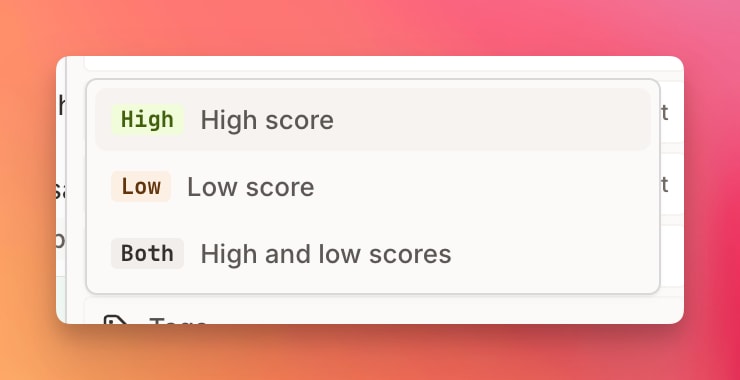
This is super helpful as a brand mention cited in a completely slopfested article is of no use to you, even though the citation is contextually relevant. High and low scores help you choose what to review first. They are not sentiment scores, and you still decide whether to reply.
Our guide to tracking mentions of a brand with a common name shows the process in detail. However the classifier AI can still make a wrong call based on a short or unclear post.
Start with AI filters today
For day-to-day brand monitoring, let your social listening read each post’s context instead of trying to list every word people might use. Try Mentionkit’s AI relevance if you want to see only mentions that are worth replying to.