
The most popular advice on social share count is also the least useful. Get more shares. Display the number everywhere. Treat the biggest total as proof that your marketing is working.
That logic breaks fast in B2B.
A post can spread widely and still attract the wrong audience, the wrong conversation, and no pipeline. Meanwhile, a small thread in the right community can surface active buyers, product comparisons, and recommendation requests that sales teams would love to see earlier. The useful question isn’t “How many people shared this?” It’s “What kind of conversation is spreading, how fast, and among whom?”
Why Chasing a High Social Share Count Is a Mistake

Marketers love simple scoreboards. A social share count looks clean, easy to report, and easy to compare. That’s exactly why it becomes dangerous.
Mailchimp makes the core problem plain. Many teams treat social shares as a primary success metric even though that misses the strategic difference between quality and volume. Their example is blunt: a 10,000-share generic post may produce no qualified leads, while a 47-share thread where people ask for product recommendations can contain multiple sales-ready prospects, as noted in Mailchimp’s social sharing guide.
High volume often means low intent
In B2B, broad reach frequently pulls you away from buying signals. People share industry jokes, trend takes, and hot-button opinions because they’re lightweight and socially safe. They don’t share those things because they’re ready to buy software.
That’s why teams that obsess over totals often drift into content built for applause instead of action. If your KPI rewards the loudest post, your strategy starts favoring attention over relevance.
Practical rule: If a post gets shared widely but the replies don’t include evaluation, comparison, pain points, or recommendation requests, it’s awareness at best. It’s not demand.
The better question is what the share means
A share can signal endorsement. It can also signal disagreement, entertainment, habit, or internal team passing. Those are not the same thing.
For demand generation, the useful interpretation is narrower:
- Buyer language: People ask what tool to use, what alternative to switch to, or which vendor solves a specific problem.
- Commercial context: The discussion sits in a place where professionals compare solutions, not where casual audiences react to headlines.
- Momentum: The conversation starts moving quickly enough that joining early matters.
If you want a better framework for turning social activity into pipeline, B2B demand generation strategies are more useful than a dashboard full of inflated share totals.
Understanding What a Share Count Actually Measures
A share count is best understood as digital word-of-mouth. It measures how often people redistribute a piece of content, a link, or a conversation across networks and audiences. That sounds simple until you remember that every platform defines “redistribute” a little differently.
A share is not just a button click
On one platform, a share may mean reposting a link to a feed. On another, it may include sending the link into a private message, quoting it with commentary, or passing it into a niche community. The practical takeaway is that a social share count doesn’t represent one universal user action. It represents a family of actions that all move a conversation from one context to another.
That’s why I treat shares less like a popularity score and more like a distribution trail. Each share says, “someone thought this was worth carrying into another room.”
Why this metric became important
The modern habit of measuring these interactions goes back to the early social era. Around 2004, MySpace became the first platform to reach one million monthly active users, which helped establish quantifiable social interactions as a core internet behavior, according to Our World in Data on the rise of social media. Since then, the metric has matured from a basic engagement signal into something teams use to track reach, resonance, and in some cases lead opportunity.
That evolution matters because a share count only becomes useful when you pair it with the rest of the picture.
A count tells you that content traveled. It doesn’t tell you whether it traveled toward buyers.
What this number is good for
Share counts still have value when used correctly:
- Content distribution checks: They help you see whether something escaped your owned audience.
- Early traction detection: They can reveal that a conversation is starting to spread before SEO or press catches up.
- Competitive monitoring: They can complement broader Share of Voice (SOV) measurement when you want to know not just who gets mentioned, but which mentions are being carried further.
If you’re building your own monitoring process, a good starting point is a lightweight workflow for free social listening. Just don’t confuse the count with the outcome.
How Different Platforms Calculate Social Shares
The phrase “social share count” sounds standardized. It isn’t. Platforms expose different actions, different interfaces, and different levels of API visibility. That makes cross-platform reporting messy, especially if you’re trying to compare intent signals from X, LinkedIn, Reddit, and Hacker News in one view.
According to ShareScore’s overview of share count calculation, share count logic varies significantly by platform because APIs differ, and Twitter’s redesign in 2015 removed public share count visibility. That single change is enough to break any simplistic “shares are shares” model.
Platform Share Signals at a Glance
| Platform | Primary Share Action | Key Intent Signal to Monitor |
|---|---|---|
| X | Reposts, quote posts, link circulation through public discussion | Quotes and replies that add evaluation, comparison, or tool recommendations |
| Reshares of posts or links into professional networks | Comments from operators, founders, or practitioners discussing implementation or vendor choice | |
| Crossposts, link sharing into subreddits, comment-driven spread | Threads where users ask for recommendations, alternatives, or help with a concrete pain point | |
| Hacker News | Link submission and discussion visibility through community engagement | Posts that attract substantive discussion from technical decision-makers around tools or trade-offs |
X gives weaker direct count data
X is still valuable for finding demand, but not because it hands you a clean public share total. Since public share count visibility disappeared there, you have to infer momentum from surrounding signals like repost patterns, quote activity, reply quality, and how quickly a discussion is propagating across related accounts.
That makes X useful, but harder to quantify with a single number.
Reddit gives richer intent context
Reddit is usually the opposite. The total spread may be smaller, but the context is often far stronger. A user asking for recommendations in a relevant subreddit is giving you a direct statement of need. Even when the count is modest, the commercial value can be high because the thread contains language buyers use before they purchase.
This is one reason many B2B teams overvalue mainstream virality and undervalue specialist forums.
The best lead signal on social often looks too small to impress a reporting dashboard.
LinkedIn and Hacker News need different reading
LinkedIn can produce highly relevant conversations, but the interpretation depends on who is engaging. A reshare by a generic creator account means less than a comment thread among operators comparing workflows, integrations, or vendors.
Hacker News is even more selective. It isn’t a classic share-first network, but when a tool, launch, or technical problem starts circulating there, the discussion quality can be unusually high. The signal isn’t “how many people clicked share.” The signal is whether knowledgeable participants are pulling the topic into serious evaluation.
What works in practice
When teams compare social share count data across platforms, three habits help:
- Normalize by context: A modest spread in a niche technical forum can matter more than broad distribution on a general network.
- Track native actions separately: Don’t merge reposts, crossposts, and professional reshares into one neat total and pretend they mean the same thing.
- Read the surrounding conversation: The count is the wrapper. The replies, comments, and quotes tell you whether there’s any buyer intent inside.
How to Read Share Counts for Buyer Intent
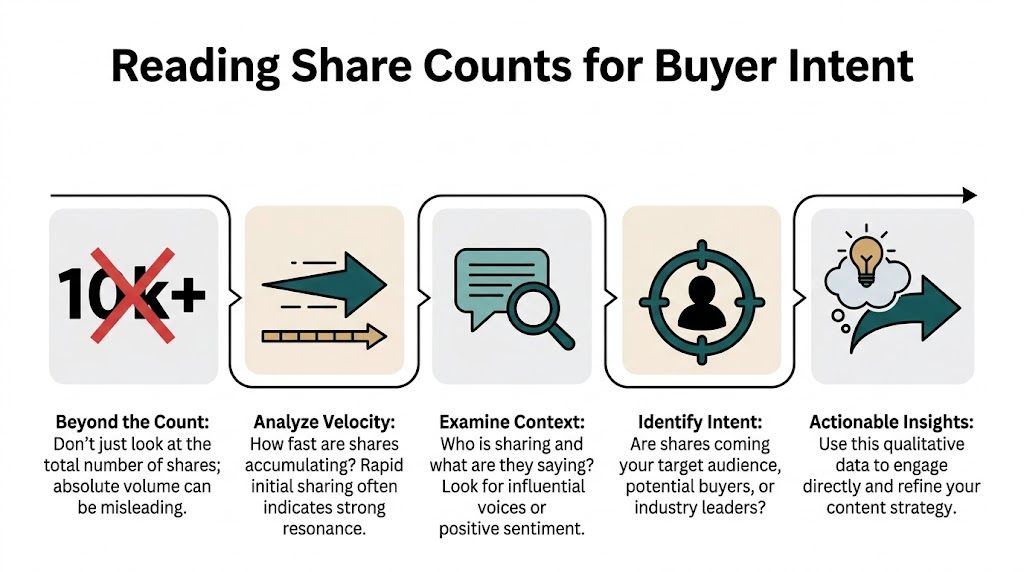
The raw number is the least interesting part of a social share count. The useful signal comes from velocity and context.
Velocity tells you when to pay attention
A slow rise can mean background interest. A fast jump usually means someone has touched a live problem. Social tracking systems often refresh newer content more frequently because social velocity decays quickly, and the first day or two is where movement matters most. In practice, I care less about a large mature total than about a fresh conversation that starts accelerating.
When a recommendation thread begins picking up shares quickly, the opportunity window is short. Buyers are actively asking peers, peers are actively responding, and vendor names are entering the conversation before a category page or comparison article ever gets visited.
Context tells you whether it matters
The 90-9-1 rule says that 1% of users drive most activity, as explained in Nielsen Norman Group’s participation inequality analysis. That matters because niche communities often look quiet on the surface. They can have low absolute sharing while still concentrating the exact people you want, such as practitioners, admins, or technical evaluators.
A small subreddit discussing a painful workflow issue can be worth more than a widely shared generic post because the participants are closer to the buying decision.
A simple filter for intent
When I review a thread, I don’t ask whether it’s “performing.” I ask whether it contains buying behavior.
Use this quick screen:
- Problem clarity: Is someone describing a real operational issue, not just reacting to news?
- Solution-seeking language: Are users asking for alternatives, comparisons, recommendations, or implementation advice?
- Relevant participants: Do the commenters look like actual users, operators, or decision-makers?
- Recent acceleration: Is the discussion getting redistributed quickly enough that entering now changes the outcome?
If the thread is small but the language is specific, don’t dismiss it. That’s often where the best leads live.
A viral joke can create reach. A modest thread that says “what are you using for this?” creates pipeline.
A Practical Workflow for Tracking High-Intent Shares
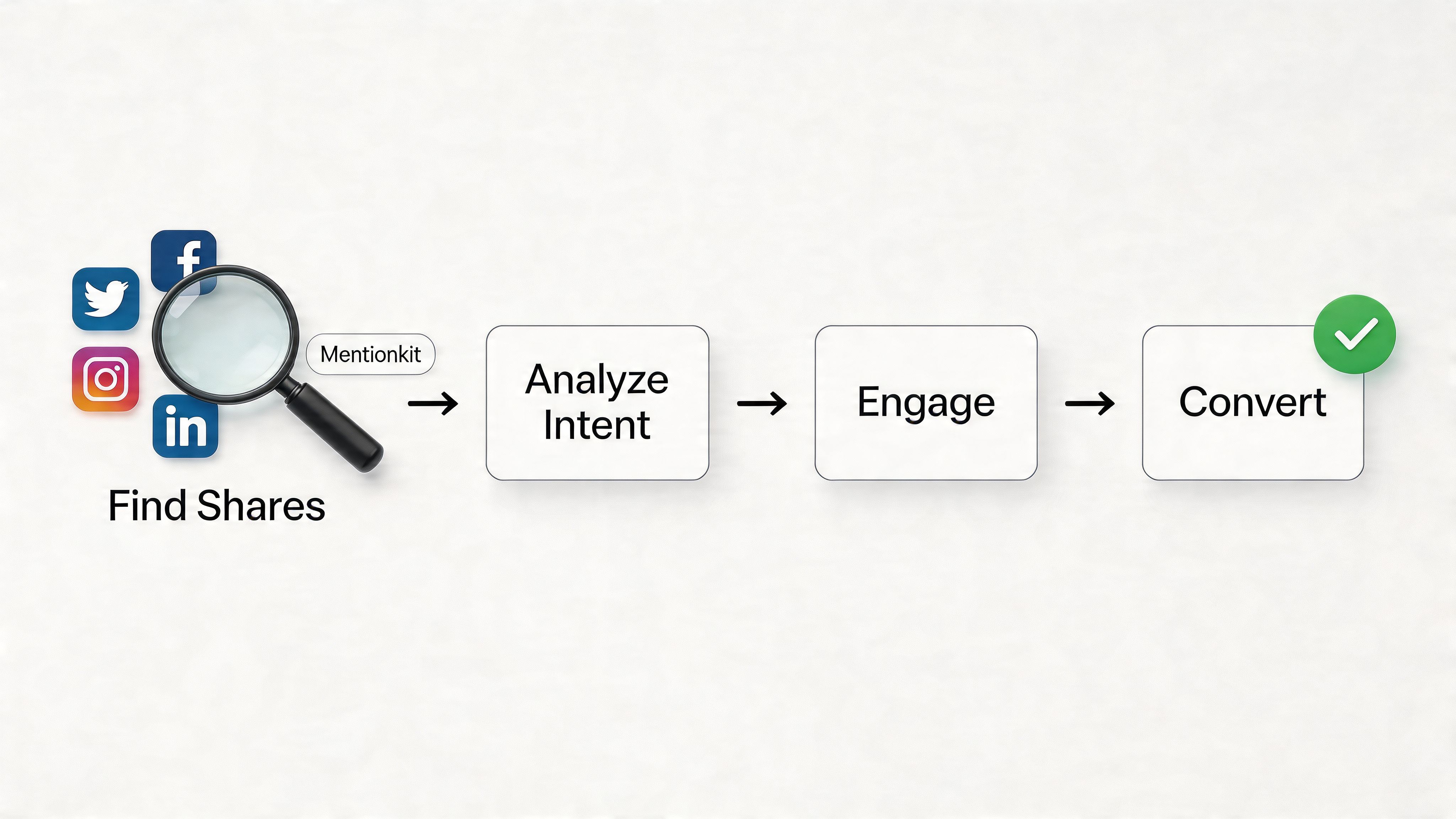
Teams often don’t fail because they lack data. They fail because they check too late, watch the wrong places, or respond with canned outreach that makes the whole effort look spammy.
Step 1 starts with narrow monitoring
Build a keyword list around commercial intent, not broad awareness. Track your brand, direct competitors, category terms, alternative phrases, and problem statements buyers write in public. Add product use cases, migration language, and “looking for” patterns.
Good monitoring inputs usually include:
- Brand comparisons: Your brand name next to competitor names or “alternative” phrasing.
- Pain-point terms: Frustrations tied to the job your product solves.
- Recommendation prompts: Phrases like “what do you use,” “best tool for,” or “need a solution for.”
- High-value communities: Relevant subreddits, LinkedIn discussions, X conversations, and technical forums.
Step 2 prioritizes freshness over volume
Social share platforms often use tiered refresh logic because newer content needs more frequent checks. Content under 24 hours old may refresh hourly, and that matters because social velocity tends to decay fast, as described in SocialSnap’s explanation of share count refresh rates. For lead generation, the practical takeaway is simple. If a mention jumps from 5 to 50 shares, that’s not a reporting detail. That’s a signal to investigate now.
Many manual workflows break. By the time someone exports a report, the thread is old, the recommendations are settled, and the chance to join naturally is gone.
Step 3 qualifies the conversation before outreach
Don’t reply just because something is moving. Check the thread first.
I use a short decision filter:
- Is there explicit need? A clear request beats vague chatter.
- Is the audience relevant? A founder, marketer, engineer, or operator in the right context matters more than a huge casual audience.
- Can you add value without forcing a pitch? If not, skip it.
- Is the conversation still open? Old threads rarely reward late brand replies.
A stronger process for this lives inside a broader social media lead generation workflow, but the principle stays the same. Speed matters only after relevance is confirmed.
Reply like a helpful participant. If your first instinct is to drop a demo link, you’re probably too early or not relevant enough.
Step 4 closes the loop
Track what happens after engagement. Which communities produce useful conversations? Which keywords surface researchers versus actual buyers? Which response styles earn follow-up questions instead of silence?
The point isn’t to build a prettier share dashboard. It’s to develop a repeatable system for spotting intent early and entering the right conversations while they’re still forming.
Stop Counting Shares and Start Conversations
A social share count isn’t useless. It’s just overpromoted.
The number can tell you that something is traveling. It can’t tell you on its own whether the conversation contains demand, whether the audience is commercially relevant, or whether now is the moment to engage. Those answers come from context, velocity, and careful reading of the thread itself.
Teams that grow from social don’t treat shares as the finish line. They treat them as a directional clue. Then they ask the harder questions. Who is talking? What problem are they trying to solve? Is this a recommendation thread, a buying committee discussion, or just noise dressed up as engagement?
If you want a complementary discipline for turning those interactions into pipeline, practical social selling strategies can help your team handle conversations with more credibility and less spam.
The shift is straightforward. Stop reporting the biggest number in the room. Start finding the small, fast-moving discussions where buyers reveal intent in public. Those are easier to miss, harder to fake, and far more useful.
Mentionkit helps teams find those conversations without manually scanning Reddit, X, LinkedIn, and Hacker News all day. You can monitor keywords, spot recommendation threads and brand mentions, prioritize relevance, and respond while the discussion is still live. If you want a faster way to turn social intent into qualified opportunities, try Mentionkit.